

Alessandra di Concilio
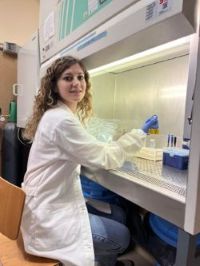
“Where insect biology meets food innovation.”
Contact: alessandra.diconcilio@unibas.it
My PhD project focuses on the development of innovative strategies for the production of cultured meat from insect-derived muscle cells as a sustainable alternative to conventional livestock systems. The main objectives are the establishment of stable immortalized cell lines, the induction of myogenic differentiation, and the promotion of functional three-dimensional muscle tissue formation. A central component of the project involves the design, characterization, and optimization of three-dimensional chitosan-based scaffolds derived from chitin extracted from Hermetia illucens, capable of supporting cell adhesion, proliferation, and organization.
The methodologies include the controlled rearing of Hermetia illucens, the isolation and culture of embryonic cells, the induction of myogenic differentiation, and the immortalization of the resulting cell lines. In parallel, three-dimensional chitosan-based scaffolds derived from Hermetia illucens chitin will be fabricated to support muscle tissue growth and structural organization in a 3D environment.
This work integrates cellular and molecular biology with biomaterials engineering, contributing to the development of sustainable, low–environmental-impact alternative protein sources.
How my position is funded
My PhD position is funded by the European Union under the NextGenerationEU programme, through the Italian National Recovery and Resilience Plan (PNRR). The funding falls within the strategic research areas defined by the Ministerial Decrees of the Ministry of University and Research (DM 630/2024).
The project is part of a broader research initiative aimed at developing sustainable food sources through advanced biotechnological approaches. Specifically, the PhD project, entitled “Biotecnologie avanzate per l'alimentazione sostenibile: linee cellulari di insetto, una soluzione nutrizionale innovativa”, contributes to the objectives of Mission 2 of the PNRR – Green Revolution and Ecological Transition.
The research activities are carried out in collaboration with Total, which supports the sustainability goals and the potential translational impact of the project, particularly in the field of cultured meat production. The project seeks to promote the development of an innovative and sustainable agri-food supply chain by leveraging insect cell lines as a novel platform for alternative protein production.
My motivations
I chose to pursue a PhD because I wanted to contribute concretely to scientific innovation in a field with significant social and environmental impact. Research on alternative proteins represents one of the most pressing challenges for the future of global food security. A PhD allows me to develop advanced expertise in cellular and molecular biology, as well as tissue engineering, while fostering scientific independence and critical thinking. After completing my degree, I aim to continue working in applied research, either in academia or industry, contributing to the development of sustainable biotechnological solutions.
A day in a PhD student’s life
A typical day during my PhD combines hands-on experimental work with data analysis. I dedicate several hours to maintaining primary Hermetia illucens cell cultures, inducing myogenic differentiation, and designing and fabricating chitosan-based scaffolds derived from the same species. An important part of my routine also involves supervising the controlled rearing of Hermetia illucens in our laboratory, as it represents the biological foundation of my research. I additionally devote time to experimental design, reviewing scientific literature, and preparing reports or manuscripts. Regular meetings with my supervisor and research group are essential for discussing results, troubleshooting challenges, and planning the next phases of the project.
My events
Poster Presentations:
- “Hermetia illucens muscle cells as a novel approach to cellular agriculture”; C. Scieuzo, S. Ouazri, A. Di Concilio, A. Lobosco, S. Letcher, D. Kaplan, P. Falabella; CNIE 2025 Siena (2025).
- “New approaches for milk quality monitoring”; C. Giannattasio, C. Cozzolino, A. Di Concilio, S. Pellecchia, S. D’Auria, A. Pennacchio; PTBF 2025 Varsavia (Polonia).