

Roberta Rinaldi
“One experiment at a time, turning mistakes into findings and navigating the maze of knowledge with patience and curiosity.”
Contact: roberta.rinaldi@unibas.it
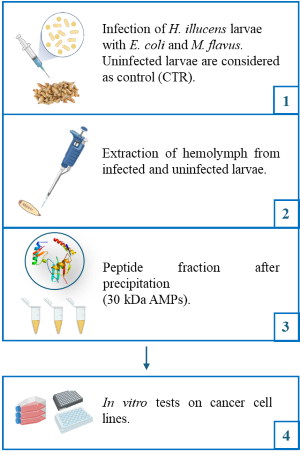
Cancer is a leading cause of death worldwide, characterized by uncontrolled cell growth and multiple mutations. Chemotherapy is often associated with harmful side effects, and cancer cells may become resistant through various mechanisms. Solutions include enhancing drug accumulation, inhibiting DNA repair, and activating apoptotic pathways. Antimicrobial peptides (AMPs), naturally occurring peptides in the innate immune system, have a wide spectrum of cytotoxic activity against cancer cells and are a promising solution. They are short chains of amino acids, high hydrophobicity, and a net charge, and interact electrostatically with cancer cell membranes to disrupt their integrity, leading to cell death. In particular, Cationic Antimicrobial peptides (CAPs), a specific type of AMPs, are abundant and show anticancer activity (Anticancer peptides - ACPs) while sparing normal cells and have net positive charges, allowing them to interact with the surface of cancer cells and disrupt their membranes trought membranolytic actions (carpet model, barrel-stave model, aggregate channel model, and toroidal model). They also show non-membranolytic actions, including: inhibition of tumor angiogenesis, induction of tumor apoptosis, interference with functional proteins, induction of mitochondrial membrane disruption and subsequent release of cytochrome C, induction of cell cycle arrest, hemolytic activity. Insects, particularly the black soldier fly (BSF), Hermetia illucens L. (Diptera: Stratiomyidae), are among the richest and most innovative source of AMPs due to their ability to live in hostile environments. In this work the peptide fraction, rich in AMPs, extracted from the hemolymph of the insect H. illucens larvae is tested on cancer cells throught many methods, such as: measurement of cell viability, western blot analysis, apoptosis and cell cycle analysis, wound healing assay, confocal microscopy analysis in order to obtain interesting results and suggesting the presence of biologically active molecules as a promising therapy in the oncology research area.
How my position is funded
My PhD project consists of one externally-funded grant - Istituto di Ricovero e Cura a Carattere Scientifico (IRCCS-CROB) (Rionero in Vulture - PZ) to the Curriculum Applied Biology International PhD Programme in SCIENCES XXXVII cycle - a.y. 2021-2022 on the restricted topic ‘Identification and characterisation of insect-derived peptides with antitumour activity’ to the Università degli Studi della Basilicata.
My motivations
I chose to undertake a PhD because I am deeply passionate about research and attached to the idea that it is crucial to make a contribution to advancing knowledge in the field of cancer. I believe that the PhD course is highly formative on a professional and personal level, as it teaches one to be able to seek solutions to complex problems, think critically and independently, develop advanced research skills and contribute something useful. After completing my PhD programme, I hope to use the skills and abilities I have acquired to continue working in research and academia on innovative projects. Ultimately, I would like that my PhD programme to open the door to opportunities that will allow me to grow professionally, contribute meaningfully and stay abreast of cutting-edge research advances.
A day in a PhD student’s life
A typical day in my PhD programme is varied and intense, involving a range of scientific activities in different disciplines. My week often starts with the maintenance of the Hermetia illucens insect colony, ensuring the appropriate conditions for their development, as without it it would be impossible to conduct all the experiments related to my research project. When I am in the laboratory at the Università degli Studi della Basilicata (Unibas) (Potenza - PZ). I conduct various microbiology and molecular biology experiments in order to study and characterise insect peptides of biomedical interest. Later, when I am not at Unibas, I dedicate myself to experimental work in the laboratory at the Istituto di Ricovero e Cura a Carattere Scientifico (IRCCS-CROB) (Rionero in Vulture - PZ), where I engage in biochemical and cellular physiology experiments to test my naturally-derived peptides in vitro on human tumour cells, in order to deepen my understanding of molecular and cellular mechanisms. Especially during the first year, my day was further enriched by attending compulsory PhD courses, which provide fundamental theoretical knowledge and methodologies on various aspects of scientific research. Attending seminars and conferences is also a key component, allowing me to stay up-to-date on the latest research trends and to network with colleagues and experts in the field. Furthermore, I dedicate time to literature review and bibliographic research, which are essential to base my work on the existing body of knowledge. Finally, I focus on writing scientific works, carefully organising and interpreting the results of my research to contribute to the scientific community. This combination of practical research, academic learning and academic writing ensures that each day is productive and in line with the rigorous demands of my PhD programme.
My events
Below it is a list of events in which I actively took part in.
Seminars:
22/11/2023 - "New molecules with antimicrobial, anticancer and antiviral effects: alternative solutions for three of the main health and social emergencies" to Fraunhofer-Institut für Molekularbiologie und Angewandte Oekologie IME (Gießen, Germany).
01/12/23 - Evento finale Progetto POR FESR Basilicata 2014 - 2020 AAA: SAFE SOS: “Nuove molecole ad attività antimicrobica, anticancro ed antivirale: soluzioni alternative a fronte di tre tra le principali emergenze socio-sanitarie”.
Posters and Abstracts in conferences:
Guarnieri, A.; Triunfo, M.; Salvia, R.; Scieuzo, C.; Ianniciello, D.; Franco, A.; Rinaldi, R.; Coltelli, M.B.; De Bonis, A.; Falabella, P. “Use of chitosan nanoparticles obtained from the bioconverter insect Hermetia illucens for the delivery of controlled-release drugs”; 3rd International Conference on Materials Science and Nanotechnology – Rome, Italy, October 3-5, 2022.
Scieuzo, C.; Salvia, R.; Giglio, F.; Rinaldi, R.; Boschi, A.; Vogel, H.; Sgambato, A.; Falabella, P. “Bioinformatic analysis of antimicrobial peptides identified in the Black Soldier Fly (BSF) dipteran Hermetia illucens (Diptera: Stratiomyidae)”; Italy– XXVI International Congress of Entomology (ICE), Helsinki, Finland, July 17-22, 2022.
Rinaldi, R.; Scieuzo, C.; Salvia, R.; Giglio, F.; Rubino, M.; Derin, E.; De Stefano, F.; Franco, A.; Falabella P. “Evaluation of the antitumoral activity of Hermetia illucens hemolymph”, XXVII Congresso Nazionale Italiano di Entomologia – Palermo, Italia, 12-16 giugno 2023. https://hdl.handle.net/11563/170976.
F. Giglio, C. Scieuzo, R. Salvia, R. Rinaldi, A. Franco, M. Rubino, E. Derin, F. De Stefano, S. Todisco, A. Capece, P. Falabella. “Optimization of the recombinant production of Hermetia illucens L. antimicrobial peptides in yeast”, XXVII Congresso Nazionale Italiano di Entomologia – Palermo, Italia, 12-16 giugno 2023. https://hdl.handle.net/11563/170895.
A. Boschi, C. Scieuzo, R. Salvia, F. Giglio, R. Rinaldi, P. Falabella. “Galleria mellonella the plastic-eater insect, source of molecules useful in the biodegradation of polyethylene and polypropylene”, XXVII Congresso Nazionale Italiano di Entomologia – Palermo, Italia, 12-16 giugno 2023. https://hdl.handle.net/11563/170935.
A. Franco, C. Scieuzo, R. Salvia, V. Pucciarelli, F. Giglio, R. Rinaldi, F. Iannielli, F. De Stefano, S. Ouazri, L. Borrelli, F. Bovera, E. Schmitt, P. Falabella. “Evaluation of antimicrobial activity of lipids extracted from Tenebrio molitor”, XII European Congress of Entomology (ECE 2023) – Crete, Greece, 16-20 october 2023.
C. Scieuzo, R. Salvia, F. Giglio, R. Rinaldi, M. Rubino, E. Derin, F. De Stefano, M. Monti, F. Cozzolino, A. Sgambato, M. Lekka, A. Vilcinskas, P. Falabella. “In vitro evaluation of the antibacterial and anticancer activity of the peptide fraction extracted from the hemolymph of Hermetia illucens”, XII European Congress of Entomology (ECE 2023) – Crete, Greece, 16-20 october 2023.
Scieuzo C., Salvia R., Giglio F., Rinaldi R., Rubino M., Derin E., De Stefano F., Pascale A., Falabella P. “The insect Hermetia illucens: a sustainable source of molecules of high biological and economic value”, 4th MS-NatMedDay, NATURAL MOLECULES AND MOLECULAR COMPLEXES – Salerno, Italia, 15-16 febbraio 2024.
Scieuzo C.; Franco A.; Salvia R.; Giglio F.; Rinaldi R.; Rubino M.; Derin E.; De Stefano F.; Pascale A.; Monti M.; Cozzolino F.; Sgambato A.; Falabella P. “Antibacterial and anticancer activity of the peptide fraction extracted from the hemolymph of Hermetia illucens”, INSECTA International CONFERENCE 2024, May 14 - 16, 2024 @ATB in Potsdam, Germany.
Ianniciello D., Salvia R., Scieuzo C., Triunfo M., Guarnieri A., Boschi A., Rinaldi R., Franco A., Lomonaco G., Dolce A., Ventura M., De Bonis A., Falabella P. “Hermetia illucens chitosan for the preservation of fresh cherry tomatoes”, INSECTA International CONFERENCE 2024, May 14 - 16, 2024 @ATB in Potsdam, Germany.
Scieuzo C.; Franco A.; Salvia R.; Giglio F.; Rinaldi R.; Rubino M.; Derin E.; De Stefano F.; Pascale A.; Monti M.; Cozzolino F.; Sgambato A.; Falabella P. “In vitro evaluation of the antibacterial and anticancer activity of the peptide fraction extracted from Hermetia illucens hemolymph”, ICE 2024- KYOTO International Congress of Entomology.
Ouazri S., Giglio F., Rinaldi R., Scieuzo C., Salvia R., Letcher S., Kaplan D., Falabella P. “INSECT CELL LINES FOR THE DEVELOPMENT OF A NEW SUSTAINABLE FOOD”, ICE 2024- KYOTO International Congress of Entomology.
My publications
Below it is a list of publications published or under reveiw during my PhD:
- Scieuzo, C.; Giglio, F.; Rinaldi, R.; Lekka, M.E.; Cozzolino, F.; Monaco, V.; Monti, M.; Salvia, R.; Falabella, P. “In Vitro Evaluation of the Antibacterial Activity of the Peptide Fractions Extracted from the Hemolymphof Hermetia illucens (Diptera: Stratiomyidae)”. Insects 2023, 14, 464. https://doi.org/10.3390/insects14050464.
Antimicrobial peptides (AMPs) are molecules produced by various living organisms, with their expression primarily in sites exposed to microbial invasion. Insects are rich sources of AMPs due to their innate immune system. In this article, had been detected AMPs in the hemolymph of Hermetia illucens (Diptera, Stratiomyidae) larvae, following infection with Escherichia coli (Gram negative) or Micrococcus flavus (Gram positive) and from uninfected larvae. Peptide component, isolated via organic solvent precipitation, was analyzed by microbiological techniques and subsequent mass spectrometry analysis allowed to specifically identify peptides expressed in basal condition and peptides differentially expressed after bacterial challenge. 33 AMPs had been identified in all the analyzed samples, of which 13 are specifically stimulated by Gram negative and/or Gram positive bacterial challenge. AMPs mostly expressed after bacterial challenge could be responsible for a more specific activity.
- Franco, A.; Rinaldi, R.; Giglio, F.; Ianniciello, D.; Boschi, A.; Scieuzo, C.; Salvia, R.; Falabella, P. “Edible insects: an overview on farming, from processing procedures to environmental impact, with a glimpse to traditional recipes and to future cultured meat”. Entomologia Generalis 2024, https://doi.org/10.1127/entomologia/2024/2651.
In this review the focus is on insect farming that has become a global food source, offering a sustainable alternative to conventional livestock production. However, challenges in scaling production, standardizing processes, and addressing regulatory gaps remain. Research and collaboration are needed to fully realize insects' potential as a sustainable protein source. Improving the nutritional content, safety, and palatability of edible insects can increase their acceptance in traditional cuisine. Future research explores the possibility of cultured meat made from insect cells, transforming future food production systems.
- Ianniciello, D.; Boschi, A.; Rinaldi, R.; Franco, A.; Giglio, F.; Scieuzo, C.; Salvia, R.; Letcher, S.; Kaplan, D.; Falabella, P. “A Comprehensive Review of Entomophagy under Legal, Historical, Safety, and Nutritional Profile”. Entomologia Generalis 2024, https://doi.org/10.1127/entomologia/2024/2524.
The review is based on different aspects of the entomophagy, for which insects are traditionally part of the human diet in around 100 countries. Despite studies on edible insects as protein sources, most focus on consumer acceptance or aversion. Insects are rich in proteins, vitamins, and minerals, and can be used in nutrition. They also efficiently bioconvert organic matter into biomass for food. As insights into quality, cultivation, nutrition, taste, and safety continue, insects' potential as future food sources will grow.