

Claudia Mangieri
“One apple a day takes hair loss away, but only if it’s an Annurca”
Contact: carmen.mangieri@unibas.it
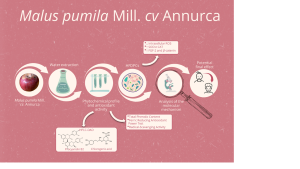
My PhD project entitled "Malus pumila Mill. cv Annurca: phytochemical profile and cytoprotective effect to contrast hair loss" focuses on the study of a plant species very common in Basilicata and Campania regions. It is a variety of apple, commonly called Annurca, with unique organoleptic properties that make it different from all other varieties. Rich in vitamins and minerals, the Annurca apple has many specialized metabolites that are very important for human health. My project starts with the extraction of these metabolites, followed by the analysis of the phytochemical profile through high performance liquid chromatography coupled with mass spectrometry in order to identify and quantify the compounds present inside. The focus is, in particular, on chlorogenic acid and procyanidin B2 which seem to be involved in the beneficial effect that this species has on hair loss. The mechanism is not fully understood, so the study is in progress by the analysis of the extract effect on cell cultures. Hair loss can be caused by many different conditions, but the drugs on the market have limited efficacy with side effects. For this reason, we are constantly looking for natural alternatives, such as the Annurca apple.
How my position is funded
My PhD position is part of the PNRR project in collaboration with the company “Nutraceutica srl”. In particular, it is part of the Ministerial Decree 352/2022 with the aim of meeting the innovation needs of enterprises and promoting the recruitment of researchers by them.
My motivations
In order to obtain my degree in pharmacy, I did an experimental thesis in the laboratory of pharmaceutical botany. This gave me the opportunity to learn about the research world. I became passionate about it, so I decided to continue my training by participating in the doctoral competition. In December 2022 I started my PhD in Sciences curriculum Applied Biology. After these years, I hope to be able to contribute actively to research in or outside the academic field. The PhD is a challenging path, but it provides a solid cultural and personal background. It allows you to live the laboratory and, at the same time, get in touch with the didactics through support for the laboratory activities of the degree courses and holding seminars to students.
A day in a PhD student’s life
My typical PhD day starts around 9.30 in the morning when I organize my daily tasks in the laboratory. Then I start my experiments doing tests on tests. At 1:30 pm I have lunch and take a walk to recharge my batteries before returning to work. In the afternoon, I analyze the results obtained from the experiments, I usually read articles in literature to compare my results and research other ideas. I have regular meetings with my tutor and lab colleagues to discuss the progress of my PhD project and plan the next steps. In all this, I attend seminars proposed by the university and prepare the materials to participate actively in conferences or to write articles.
My events
- “I International Workshop PAPRIKANET” (Matera, 2022)
- “Iª Giornata sulla cooperazione interregionale e transazionale” (Matera, 2023)
- “1° Congresso Intersocietà sui prodotti vegetali per la salute: il ruolo delle piante medicinali nella medicina moderna” (Padova, 2023)
- “II International Workshop PAPRIKANET” (Maratea, 2023)
- “III International Workshop PAPRIKANET” (Potenza, 2023)
- “Fitochimica e Studio degli Endemismi Vegetali” (Rome, 2024)
- “International Congress On Natural Products Research” (Krakow, 2024)
My publications
“Malus pumila Mill. cv Annurca apple extract might be therapeutically useful against oxidative stress and patterned hair loss” (2024) DOI: 10.1002/2211-5463.13805.
This article contains a small part of my PhD project. In particular, this study aims to investigate the role of an Annurca apple extract in preventing patterned hair loss or androgenetic alopecia by testing it on human follicle dermal papilla cells (HFDPCs) for the first time. Treatment of HFDPCs with Annurca apple extract counteracts intracellular reactive oxygen species accumulation by increasing the activity of antioxidant enzymes such as superoxide dismutase 2 and catalase. Furthermore, treatment with Annurca apple extract increases β-catenin and fibroblast growth factor 2, which are involved in hair growth stimulation. These data suggest that Annurca extract may be a potential use in nutraceutical field for preventing or treating hair loss.
“An Insight into Citrus medica Linn.: A Systematic Review on Phytochemical Profile and Biological Activities” (2023) DOI: 10.3390/plants12122267.
Citrus medica Linn. has been used for centuries in medicine for its antioxidant, anti-inflammatory, antimicrobial, antiviral and antihyperglycemic properties. These activities are related not only to the presence of macronutrients and micronutrients, such as vitamins, minerals, amino acids, but also to specialized metabolites, such as flavonoids (e.g. apigenin, hesperetin, naringenin, rutin, quercetin), coumarins, terpenes and phenolic acids (e.g. p-coumaric acid, trans-ferulic acid and chlorogenic acid). Many studies have reported this species’ chemical and biological properties, but the literature has never been analyzed via a systematic approach. For this reason, using PubMed and Scopus as databases, a systematic review of C. medica’s chemical composition and biological properties was performed to inspire new research approaches and increase its application.
“The healing bitterness of Gentiana lutea L., phytochemistry and biological activities: A systematic review” (2023) DOI: 10.1016/j.phytochem.2022.113518.
Plants in the Gentiana genus have historically been used to treat a wide range of diseases. Still, only in the last years the focus is on the biological activities of Gentiana lutea Linn. Several in vitro/vivo investigations and human interventional trials have demonstrated the promising activity of G. lutea extracts against oxidative stress, microbial infections, inflammation, obesity, atherosclerosis, etc.. This systematic review, performed using Pubmed and Scopus databases, summarizes the major specialized bitter metabolites and the biological activity data obtained from different cell lines, animal models and human interventional trials.