

Giuseppe Larotonda
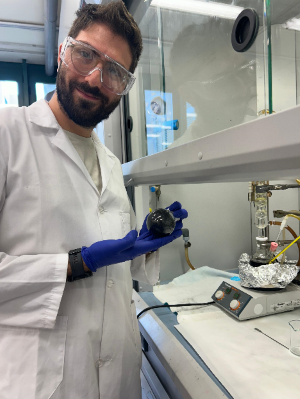
“Earth is not renewable, energy could be. You have just to add a little bit of colorant!”
Contact: giuseppe.larotonda@unibas.it
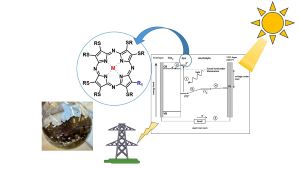
The aim of this Ph.D. project is to synthesize organic molecules for use in optoelectronic, especially photovoltaics applications. The importance of organic photovoltaics (OPV) is increasing because most of the panels on the market nowadays are made by inorganic matrix as silicon because it provides discrete current yield and stability in time. Silicon panels have also several issues related to the high production costs and difficulties in end-of-life disposal. By the other hand, OPV allow to reduce production and disposal costs, but above all there is the possibility of using the molding technique to produce flexible and transparent panels that can be used in completely different ways than traditional silicon ones. The problems that affect this technology are related to the low efficiency of energy conversion and the low stability due to the action of atmospheric agents.
From a structural point of view OPV cells consists of two components an electron acceptor and a donor. The donor is capable of absorbing electromagnetic radiation and if energy is equal to the HOMO-LUMO orbitals energy gap promotes the jump of an electron from the HOMO to the LUMO. This process leads to the formation of an exciton or electron-hole pair.
The acceptor is used in combination with the donor because it attracts the electron to itself before transferring it to the electrode while the hole moves in the opposite direction.
It follows that donor unit must be photoabsorbent material at the wavelengths of the solar emission spectrum, shall have a high hole mobility and HOMO level shall be higher than HOMO of the acceptor unit.
Graphene, fullerene and TiO2 are widely used as acceptor units therefor to have good cells is important to modulate the synthesis of donor unit to obtain compounds that have a good interaction with these materials.
The selected molecules are thialkyl-porphyrazines from tetrapyrrole family, in which pyrrolic units are linked by nitrogen bridges and have as peripheral substitution thialkyl groups that can be functionalized in different ways to have the interaction with the acceptor unit.
What I do is design and synthesize thialkyl-porphyrazines using the reference methodologies for synthesis and characterization of this type of compounds and their relative metal complexes. For the characterization, I use the NMR, Mass Spectrometry, UV-Vis Spectroscopy both emission and absorption, but also voltammetry and electronic microscopy.
How my position is funded
My position is funded by Tech4you that is a consortium formed by universities, public administration, research centre and private companies from south Italy, most from Calabria and Basilicata region. I’m part of a bigger project ranked 2nd nationally and 1st for scientific quality of the program that is funded with PNRR. More information at: https://www.tech4youscarl.it/
My motivations
I choose to pursue with a PhD because research is something that can modify the future of society to make the world a better place. The field of renewable energy in which I’m working is very interesting and can grow more and more. So, I would like to leave my contribution to a better world in the future. After the degree, what I want to do is continue my research work in renewable energy field or in similar field. I want to be a researcher!
5) A typical PhD day starts with a coffee with colleagues, other PhD students in other fields, networks are the first thing to develop during a PhD in my opinion, so after this, I go in the lab and start to work. The days change following lab activities, depends on if I have to do synthesis or purifications or analysis of compounds. If I have to set up a synthesis, first things are calculations and then I prepare all the stuff necessary. When there is a purification, I prepare the set up or if I have to analyse the synthesized compound, I prepare the instrument and take the measurements. At the end of the day I plan the work for the following day and set up the laboratory.
My events
- “XIV International School of Organometallic Chemistry” in Camerino (MC);
- “XLIX National Congress of Inorganic Chemistry” in Perugia where I presented a poster entitled “Novel Thienil-substituted Porphyrazine complexes for photovoltaic applications”;
- “XXVIII National Congress SCI2024 Chemistry Element of Future” in Milan where I presented a poster entitled “Synthesis and Catalytic Activity of a β-η1-Pd(II)-Thioethyl Porphyrazine Complex”.