

Francesco Iannelli
Insect-Powered Sustainability: Transforming Agri-Waste into High-Value Solutions.”
Contact: francesco.iannielli@unibas.it
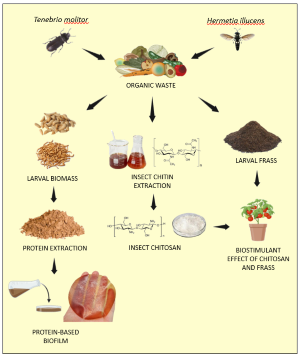
The aim of this Phd project is to develop a sustainable and environmentally friendly agri-food chain waste management through the insect bioconversion process and in particular with the yellow mealworm (Tenebrio molitor) and the black soldier fly (BSF, Hermetia illucens). These species are capable of digesting a variety of substrates or by-products converting them into insect biomass and other secondary products of high biological and economic value. This could represent a commercially promising resource for regional and national agri-food companies, stimulating a transition to a circular economy and reducing pollution and costs.
The first product of interest is the larval biomass itself, already authorized as animal feed for aquaculture, poultry and pig feeds (Commission Regulations [EU] 2017/893 and 2021/1372). Indeed, larval biomass has high protein (~30-50%) and lipid (~30-40%) content. Larval biomass will be valorised through the realization of protein-based biofilms. Laboratory-scale tests will be carried out for the extraction of proteins from bioconverting insects and a methodology for the production of protein-based biofilms will be developed.
Among the other products obtained there is the frass, that is all the waste remaining at the end of the breeding, consisting of a mix of excrement, parts of food not completely consumed and parts of dead insects. Frass, could be used in sustainable cultivation as an organic fertilizer. However, the chemical composition of frass is highly variable. Determination of frass quality from different rearing substrates will be assessed by determining the concentrations of macronutrients (total organic carbon [C], nitrogen [N], C/N ratio, phosphorus [P] and potassium [K]) and micronutrients. There will be done also microbiological analysis on the different frass obtained. Subsequently, pot tests will be set up in a greenhouse to evaluate the effect of insect frass on the cultivation of different horticultural plants.
Furthermore, the circularity of insect breeding is also expressed because the only waste, pupal exuviae and dead adults, can be used for the extraction and production of insect chitin The insect-based chitin and chitosan (chitin deacetylated derivate), can inhibit the proliferation of many bacteria, fungi and yeasts, with different mechanisms, not all fully clarified. Insects can be an alternative and non-seasonal source of chitin and chitosan, more sustainable than ocean crustaceans. Despite the well-known beneficial effects of chitosan against fungal pathogens and other plant pests, there are still few studies investigating insect-derived chitosan as bio-stimulant and elicitor in cultivation practices. The use of insect-derived chitosan could help to reduce the agricultural industry’s trust on chemical pesticides, for an increasingly green agriculture.
How my position is funded
Tech4You - Technologies for climate change adaptation and quality of life improvement
(https://www.tech4youscarl.it/)
Scope of intervention: “5. Climate, Energy and Sustainable Mobility”
Identification code ECS00000009 – CUP C43C22000400006
Spoke 3 - Smart technologies for a sustainable food and forestry supply chain
GOAL 3.3 - PP 3.4.1
My motivations
Since I was a child, I have always cultivated a particular interest in scientific disciplines and in particular in biology. Thanks to the bachelor degree’s experimental thesis, a strong interest in the numerous fields of application of insects and entomological biotechnologies has grown in me. Later, I was able to deepen my knowledge and acquire further experience in this research field thanks to the postgraduate traineeship carried out in France, within the Erasmus Plus project. Then, with the master degree's thesis I was able to deepen my knowledge about microbiology and the possibility of requalifying waste products from the agricultural supply chain thanks to scientific research. So, after my studies I decided to apply for this PhD project because it is aligned with my previous studies and experiences, but also because I was curious to work in an academic team of research.
After the PhD degree, I would like to continue developing specialized expertise with a postdoctoral research. This could help for a hypothetical academic or industry career.
A day in a PhD student’s life
I usually start my PhD day by organizing my tasks. I start by checking emails and my to-do list, then I plan experiments and organize reading materials. After that, I often spend the first part of the morning reading literature or reviewing research papers. Then I start lab work and organize experiments according to the moment of the day and the lunch break. I often spend the afternoon running experiments or analysing data. The day often ends with a meeting with a supervisor, organizing notes and planning the next day’s tasks, or brainstorm ideas.
My events
- CNiE 2023 Palermo. Franco A., Scieuzo C., Salvia R., Pucciarelli V., Iannielli F., Ouazri S., Borrelli L., Bovera F., Schmitt E., Patrizia Falabella. Evaluation of antimicrobial activity of lipids extracted from Yellow Mealworm Tenebrio molitor (Coleoptera: Tenebrionidae) (POSTER)
- CNiE 2023 Palermo. D. Ianniciello, R. Salvia, C. Scieuzo, M. Triunfo, A. Guarnieri, A. Boschi, A. Franco, G. Lomonaco, F. Iannielli, A. Dolce, M. Ventura, A. De Bonis, Patrizia Falabella. Usage of insect-based chitosan for the preservation of fresh fruits (POSTER)
- ECE 2023 Creta. A. Franco, C. Scieuzo, R. Salvia, V. Pucciarelli, M. Rubino, E. Derin, S. Ouazri, F. Iannielli, F. L. Borrelli, F. Bovera, E. Schmitt, P. Falabella. Evaluation of antimicrobial activity of lipids extracted from Hermetia illucens reared on different feeding substrates (POSTER)
- ECE 2023 Creta. A. Franco, C. Scieuzo, R. Salvia, V. Pucciarelli, F. Giglio, R. Rinaldi, F. Iannielli, F. De Stefano, S. Ouazri, L. Borrelli, F. Bovera, E. Schmitt, P. Falabella. Evaluation of antimicrobial activity of lipids extracted from Tenebrio molitor. (POSTER)
- ECE 2023 Creta. R. Salvia, C. Scieuzo, M. Triunfo, A. Guarnieri, D. Ianniciello, A. Franco, G. Lomonaco, F. Iannielli, A. Dolce, M. Ventura, A. De Bonis, P. Falabella. Usage of insect-based chitosan for the preservation of fresh fruits (POSTER)
- 4th MS NatMedDay 2024 Salerno. Antonio Franco, Carmen Scieuzo, Rosanna Salvia, Valentina Pucciarelli, Francesco Iannielli, Sofia Ouazri, Ilaria Caivano, Luca Borrelli, Fulvia Bovera, Eric Schmitt, Patrizia Falabella. Antimicrobial activity of lipids extracted from Hermetia illucens larvae reared on different substrates. (POSTER)
- INSECTA 2024 POTSDAM. Antonio Franco, Carmen Scieuzo, Rosanna Salvia, Valentina Pucciarelli, Sofia Ouazri, Francesco Iannielli, Miriam Viola, Ilaria Caivano, Luca Borrelli, Fulvia Bovera, Eric Schmitt, Patrizia Falabella. Lipids extracted from Hermetia illucens reared on different substrates: evaluation of antimicrobial activity. (Oral Communication)
- INSECTA 2024 POTSDAM. Carmen Scieuzo, Antonio Franco, Rosanna Salvia, Micaela Triunfo, Francesco Iannielli, Andrea Boschi, Valentina Pucciarelli, Fulvia Bovera, Ambrogio Laginestra, Eric Schmitt, Patrizia Falabella. Valorization of fruit byproducts through bioconversion by Hermetia illucens (Diptera: Stratiomyidae). (POSTER)
- ICE 2024 Kyoto. Franco A., Scieuzo C., Salvia R., Pucciarelli V., Iannielli F., Caivano I., Triunfo M., Guarnieri A., Borrelli L., Bovera F., Schmitt E., Falabella P. Evaluation of antimicrobial activity of lipids extracted from Hermetia illucens reared on different feeding substrates. (Oral Communication)