

Marilena Caporale
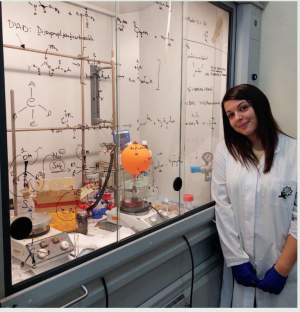
‘Revolutionizing Pest Control: Crafting Eco-Friendly Chemistry for a Greener Tomorrow’
Contact: Marilena.caporale@unibas.it
Weeds are a major agricultural problem often controlled by agrochemicals, which pose environmental and health risks. Biological agents like fungi offer a natural, eco-friendly alternative, producing specific bioactive metabolites with low toxicity. However, challenges include limited fungal sources, complex isolation, and expensive production. Chemical synthesis of fungal metabolites, such as (±)-deoxyradicinin and Ascaulitoxin, offers an effective solution. These synthesized compounds show potential as bioherbicides, providing a scalable, cost-effective alternative to natural products for weed control and plant disease prevention.
How my position is funded
My PhD (XXXVIII cycle, in Sciences, Chemical Sciences curriculum) is conducted within the National Research Center Agritech (https://agritechcenter.it/it/). Agritech is part of the National Recovery and Resilience Plan and is the National Center for the Development of New Technologies in Agriculture. It is a project based on the use of enabling technologies for the sustainable development of agri-food production, with the goal of promoting adaptation to climate change, reducing environmental impact, developing marginal areas, ensuring safety, traceability, and the distinctiveness of agro-forestry and food supply chains.
In particular, my PhD project is funded under Spoke 2, specifically Task 2.2.4, which focuses on biopesticides and biostimulants.
My motivations
I chose to continue my studies by pursuing a PhD because of my deep passion for chemistry, which was further solidified during my master's degree in Chemical Sciences, where I focused on organic chemistry. During this three-year research period, I developed a strong interest in natural compounds and their enantioselective synthesis. I also acquired skills in organic synthesis, interpreting spectra for chemical characterization, and purifying compounds. The experience I gained while working on my thesis, particularly in the laboratory environment, fueled my desire to delve deeper into the field and contribute to scientific research. After earning my PhD, I hope to remain in academia, where I can take on new challenges and continue to advance my knowledge while contributing to the academic community.
A day in a PhD student’s life
In the morning, I arrive at the laboratory early. To start the day off right, I have a coffee with my colleagues. Immediately afterwards, I go up to the laboratory, put on my lab coat and start the day. Generally, in the morning I treat the reactions started the previous afternoon. I interrupt them, filter them and dry them in the rotavapor. I prepare an NMR sample and go to the instrument to record a spectrum of the raw material. If the spectrum shows the desired reaction product (as fortunately happens most of the time) I organize and plan the purification of the crude on a chromatographic column. Generally, since the purification takes a long time, I start immediately after the lunch break. I select the column of the right size and length, fill it with silica up to more than half its height and load my sample. I elute the column with an appropriate mixture, and in the meantime I collect various fractions in succession, each in a single tube.
I check each fraction collected on TLC, and I collect in the same flask all the fractions that have the same stain on the plate. I concentrate the flask with the rotavapor, so as to eliminate the excess solvent, and I go to the NMR again, to make sure I have obtained the clean product!
My events
Participation in ISSNP - International Summer School on Natural Products - Maratea from July 2 to July 7, 2023
Marilena Caporale, Giulia Marsico, Patrizia Scafato, Stefano Superchi ‘Asymmetric synthesis of the an usual amino acid AHMHA, an unit in Marine Metabolite Perthamide C’. POSTER, MARATEA (MT) 2-7 LUGLIO 2023, ISSNP.
Marilena Caporale, Dolores Ianniciello, Giulia Marsico, Antonio Evidente, Stefano Superchi, Patrizia Scafato ‘Diastereo- and enantioselective synthesis of precursors of the natural herbicide ascaulitoxin’ POSTER, MARATEA (MT) 2-7 LUGLIO 2023, ISSNP.
Participation in the 3rd edition of SCI*C – SCHOOL IN CHEMISTRY COMMUNICATION, held in Rimini, from November 12-13, 2023.
Marilena Caporale, Patrizia Scafato, Stefano Superchi ‘Flexible dithienyl probes for determining the absolute configuration of chiral molecules’ POSTER, RIMINI 13-15 NOVEMBRE 2023 – MYCS 2023 – ATTI pag. 199.
Marilena Caporale, Dolores Ianniciello, Maria Teresa Petruzzi, Giulia Marsico, Antonio Evidente, Stefano Superchi, Patrizia Scafato ‘Stereoselective synthesis of the precursors of natural phytotoxin ascaulitoxin’ FLASH PRESENTATION, BARI 7-9 FEBBRAIO 2024 – CINMPIS – ATTI pag. 60.
Marilena Caporale, Antonio Evidente, Maurizio Vurro, Patrizia Scafato, Stefano Superchi ‘Approach to the stereoselective synthesis of ascaulitoxin aglycon and phytotoxicity of its intermediates’ POSTER, PORTICI (NA) 27-28 FEBBRAIO 2024 - AGRITECH- Spoke 2 MID-TERM MEETING. ATTI pag. 37.
Marilena Caporale, Antonio Evidente, Mauro Marra, M Vurro, Stefano Superchi Patrizia Scafato ‘3-deoxyradicinin as biopesticide: efficient synthesis and mechanism of action’ POSTER, PORTICI (NA) 27-28 FEBBRAIO 2024 - AGRITECH- Spoke 2 MID-TERM MEETING. Atti pag. 38.
Marilena Caporale, Antonio Evidente, M Vurro, Patrizia Scafato, Stefano Superchi ‘A novel approach to the stereoselective total synthesis of four stereoisomers of the fungal phytotoxin ascaulitoxin aglycone.’ POSTER, MILANO 26-30 AGOSTO 2024 -XXVIII SCI National Congress. Atti ORG-PO-037.