

Angelica Rebecca Zizzamia
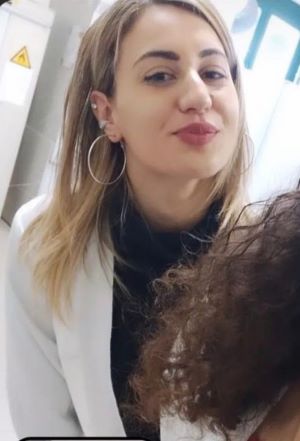
“I hope that my research can contribute, even in a small way, to raising awareness in the community of a greater interest in the environment.”
Contact: angelicarebecca.zizzamia@unibas.it
In my doctoral project, of which I am in the second year and the title of my project is “Innovative methodologies in the purification of waste and contaminated water”. I deal with innovative methods for the purification of wastewater. In recent decades, the scientific community has been interested in so-called emerging contaminants, natural or synthetic substances that sometimes escape traditional biological methods of water remediation. For this reason, new methods have been developed, generally physical (adsorption, filtration, osmosis) and chemical (advanced oxidation processes, AOPs). In my project, I mainly deal with adsorption on natural materials such as biochar or clays (for example varicolored clays, a material that emerges in the province of Potenza) and advanced oxidation processes. The adsorption experiments are conducted in batch. Among the AOPs, attention is paid to the processes of photodegradation (degradation of pollutants by radiation, with the help of oxidants such as potassium peroxymonosulphate PS, potassium peroxymonosulphate PMS or hydrogen peroxide H2O2) and photocatalysis (photochemical degradation with aid of the heterogeneous catalyst TiO2), with the use of a solar simulation device (in fact, the processes aided by radiation simulate what happens in nature through sunlight). Among the emerging pollutants, there are drugs, such as that belonging to the class of 5-phosphodiesterase inhibitors (sildenafil, tadalafil and analogues), taken under medical prescription to treat erectile dysfunction but increasingly used by young people for recreational purposes. The sale and consumption of these drugs have increased significantly in recent years and consequently their levels in the environment. The harmful effects that their presence in environmental matrices can have on humans and the ecosystem are not yet well known, but their recalcitrance, low biodegradability and continuous release into the environment are a wake-up call. In fact, in silico toxicological assessments have also been carried out on these drugs and toxicity tests will subsequently be carried out. The focus of my project so far has been on sildenafil, the active ingredient in Viagra, and partly on tadalafil, the active ingredient in Cialis. I do not rule out extending the research to other analogues such as avanafil and vardenafil in the future. The degradation and adsorption curves are obtained by liquid chromatography coupled to UV detection (LC-UV), investigating sildenafil at 254 nm and tadalafil at 290 nm. The tests conducted so far show that the various methods used are quite effective in removing drugs; obviously, in the case of adsorption there is a physical removal of the drug, thanks to the weak interactions between the molecule and the adsorbent surface (adsorption was confirmed by preliminary XPS tests); future studies also plan to focus on recovering the material without using organic solvents. In the case of AOPs, the photochemical degradation of the drug is guaranteed (for sildenafil, PMS has proven to be the best oxidant). The difference compared to adsorption is that in the case of AOPs there is a degradation of the molecule, with the formation of photoproducts. The photoproducts are identified via liquid chromatography coupled to mass and tandem mass spectrometry (LC-MS and LC-MS/MS). Since the products formed may be toxic, sildenafil, tadalafil and their photoproducts have undergone in silico toxicological evaluations through the ECOSAR program which relates chemical structure and toxicity. It has emerged, in fact, that a photoproduct of sildenafil, as well as a product of the human metabolism of the same drug (N-desmethyl sildenafil), is more toxic than the same precursor. As can be understood, new paths will be explored, explored and improved in the second part of the doctorate.
How my position is funded
My scholarship is ensured with external funding from the FSC Basilicata Region.
My motivations
After my master's degree, I chose to continue my studies by obtaining a research doctorate because it is not only a full immersion in research linked to the disciplinary field to which it belongs, but it is also considered a path of self-knowledge and awareness of the world of work, while remaining in a well-known and therefore familiar environment. In the interaction and action that takes place every day I am learning to put into practice and train communication skills, especially when presenting research at conferences or seminars, internal or external to the faculty. I am becoming familiar with every single corner of the laboratory, learning to use instruments never seen before, I manage my work autonomously, comparing myself with my supervisor but still having decision-making power over my activities which in the years of graduation and during the experimental you don’t have it. The other undeniable advantage of the doctorate is the exclusivity and personalization of the path. Since it is an individual path, it differs from the teaching methods of three-year and master's degree courses and focuses on the interests, cognitive, expository and critical tools characteristic of each student pursuing the doctorate. In the years in which I am participating in the doctorate, I am having the opportunity to study or carry out an internship in a company or a research activity abroad, which is certainly an interesting experience, essential to do at least once in the life. The call for my doctorate requires at least 6 months abroad and I will shortly organize my departure which I expect for January 2025. The PhD is the highest level of education that can be obtained in Italy. Those who obtain this title can do research in their field of interest. The doctorate is also useful for participation in competitions, where this level of training is counted positively for the final evaluation. However, the main career opportunities are linked to the academic and teaching sphere. A research doctor can in fact aspire to work as a researcher or university professor, however, with the doctorate title, it is possible to find employment in both the public and private sectors within companies, businesses and private research institutions. What I hope is that, whatever my career destiny (even if I have in mind what I would like to do after the doctorate), these 3 years of doctorate will give me all the cognitive tools and not only to be able to best exercise my profession, always with passion and dedication. The PhD path is an education in its entirety, not only from the point of view of one's own subject of interest and for me it has been and continues to be a truly captivating challenge, not without difficulties obviously. Halfway through the course, I feel like saying that it is an experience absolutely worth having, essential after the 5 academic years, because for the first time you truly become protagonists of your own work and research. I strongly advise all new graduates, if they have the opportunity, to continue their studies with a research doctorate.
A day in a PhD student’s life
I am enrolled in the XXXVIII cycle Doctorate in “Sciences”. From Monday to Friday, I am at the university, at the “Environmental Photochemistry” laboratory, to carry out my research activity. I usually arrive at university around 8.30 am after a bus journey of around 90 minutes. After a coffee with my supervisor Prof. Filomena Lelario, I start with my work. I generally start with the practical part (preparation of solutions, starting photodegradation or adsorption experiments, etc…). Immediately afterwards I turn on the HPLC-UV instrumentation, so as to prepare it for the analysis of the samples. Sometimes, although rarely, it happens that samples resulting from the previous day's analysis are injected. In my downtime, I read literature articles or do data processing. In the months of January-March 2024, for the publication of the article, I dedicated myself mainly to its drafting, together with my research group. At lunchtime, I take a break of about an hour and then resume my activities until 5.00 pm. When I am unable to finish that day's scheduled activities by 5.00 pm, I stay at the university until 7.00 pm. It must be taken into account that research activity, as well as being exciting and fascinating, also has negative sides: the expected results will not always, and not immediately, be achieved, times may be longer than expected, even weeks, so the schedule can slip significantly. Sometimes, getting discouraged may seem like the only solution, which is because it is important not to lose heart and above all to do teamwork with colleagues, with the entire research group, and above all with your supervisor. I feel lucky, because I have established a relationship of trust and collaboration with my supervisor, who I turn to for any doubts and perplexities that she, always available and patient, manages to resolve and clarify. I report all the activities carried out in a diary so as to be able to have a clear picture of each experiment carried out at the end of the doctorate for the writing of the thesis. When new thesis students arrive in the laboratory, I support them by illustrating the functioning of the instruments first and helping them in their actual experimental activities afterwards. This is a real challenge, because in this case we find ourselves having to pass on what we have learned in previous years with so much study and dedication. And there are so many satisfactions! Furthermore, during the first year of the doctorate, I followed theoretical courses, some common to the entire XXXVIII cycle of which I am part and others specific to my curriculum, which were followed by exams with the issuing of a certificate of attendance. Often, there are seminars to which we doctoral students are invited, many of which I participate in as they are interesting, as well as necessary to achieve the credits for admission to the following doctoral year. We are also offered national or international conferences, in which to participate as listeners or speakers (in the latter case, a doctoral student can present a poster in the specific session or make an oral communication in which he illustrates part of his current research).
My events
- Fourth International Conference on Risk Assessment of Pharmaceuticals in the Environment (ICRAPHE) Barcellona 09/10/2023 - 10/10/2023 “Comparison of advanced oxidation processes for the degradation of sildenafil in water” A.R. Zizzamia, C. Tesoro, G. Bianco, S.A. Bufo, R. Ciriello, L. Scrano, M. Brienza, F. Lelario POSTER;
- SICA 2023 Palermo 12/09/23- 15/09/23 “Fotodegradazione di tadalafil e sildenafil in soluzioni acquose: efficacia di rimozione, cinetiche e fotoprodotti” A.R. Zizzamia, C. Tesoro, S.A. Bufo, M. Brienza, G. Bianco, R. Ciriello, L. Scrano, F. Lelario POSTER;
- 5th International Conference on Risk Assessment of Pharmaceuticals in the Environment (ICRAPHE) Anacapri (Na) 24/06/24-25/06/24 “Innovative methods to remove PDE5 inhibitors from polluted water” Angelica Rebecca Zizzamia, Carmen Tesoro, Giuliana Bianco, Sabino A. Bufo, Rosanna Ciriello, Monica Brienza, Laura Scrano, Filomena Lelario ORAL COMUNICATION;
- SCI XXVIII National Congress 2024 Milano 26/08/24- 30/08/24 “Efficient photooxidation processes for the removal of sildenafil from aqueous environments: A comparative study” A. R. Zizzamia, C. Tesoro, G. Bianco, S.A. Bufo, R. Ciriello, M. Brienza, L- Scrano, F. Lelario POSTER.
My publications
A. R. Zizzamia et al., “Efficient photooxidation processes for the removal of sildenafil from aqueous environments: A comparative study,” Case Stud. Chem. Environ. Eng., vol. 9, no. February, p. 100708, 2024, https://doi.org/10.1016/j.cscee.2024.100708.
The erectile dysfunction drug sildenafil has attracted a great deal of attention in recent years due to its widespread legal and illegal use around the world and its increasing use by young people for recreational rather than medical purposes. Due to sildenafil's high stability in various environmental conditions and its accumulation or phototransformation in receiving waters, this dangerous trend poses a significant risk to both human health and the environment. Therefore, in-depth studies are needed to find innovative methods for completely removing sildenafil from the aquatic environment while limiting the formation of more toxic derivatives. This study investigated the efficacy of photooxidation processes for removing sildenafil and its potentially toxic derivatives from water. Distilled water and synthetic wastewater were treated with three different oxidants: peroxymonosulfate (PMS), persulfate (PS) hydrogen peroxide (H2O2), and a heterogeneous catalyst, TiO2. The investigation also considered the formation of potentially toxic phototransformation products, performing a tentative structural identification by LC-ESI-MS and MSn. The results proved that the Sunlight/PMS system is the most effective for entirely and environmentally friendly removal of this drug and its transformation products from aqueous environments, achieving complete degradation in distilled water and synthetic wastewater after 80 and 130 minutes of irradiation, respectively. Toxicity testing with Vibrio fisheri confirmed the non-toxic nature of the phototransformed products. This study highlights the potential of Sunlight/PMS photooxidation as a promising strategy for mitigating the environmental risks associated with sildenafil contamination.