

Sofia Ouazri
“Time to “Meat” Insects!”
Contact: sofia.ouazri@unibas.it
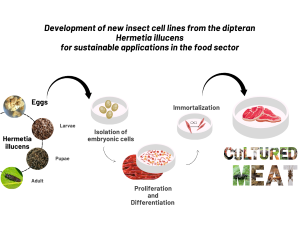
This PhD project aims to develop an innovative approach for producing animal proteins by cultivating muscle cell lines derived from Hermetia illucens insect embryos. In light of the growing global demand for sustainable food sources, this research is crucial as it addresses the environmental and economic limitations of traditional meat production. Insect cells are being utilized due to their adaptability to a broad range of environmental conditions, reduced resource requirements, and suitability for large-scale production. By establishing stable and immortalized insect muscle cell lines, this research could lay the foundation for scalable, eco-friendly, and nutritious cultured meat production. The methodologies include rearing Hermetia illucens, isolating and cultivating embryonic cells, promoting their differentiation into muscle cells, and ultimately immortalizing these lines for continuous production. This research has the potential to significantly contribute to the field of cellular agriculture, offering a sustainable alternative to conventional livestock farming.
How my position is funded
My position is funded by the European Union under the NextGenerationEU initiative, specifically within the framework of the National Recovery and Resilience Plan (PNRR). The funding is provided through the research topics outlined in the Italian Ministry of Education, University and Research Decrees (DM 352/2022). This PhD project is part of a broader research initiative aimed at developing sustainable food sources through innovative biotechnological approaches. The specific project, titled "Development of new insect cell lines from the dipteran Hermetia illucens for sustainable applications in the food sector," is aligned with the goals of "Mission 2: Green Revolution and Ecological Transition" of the PNRR. The project benefits from the collaboration with Total, which supports the research's sustainability objectives and application potential in the food sector, particularly in cultured meat production. The project aims to contribute to the development of a sustainable agri-food chain by utilizing insect cell lines as a novel food source, which has potential applications in cultured meat production.
My motivations
I chose to pursue a PhD because of my passion for scientific research and my desire to contribute to solving global challenges through innovative biotechnology. A PhD offers the opportunity to deepen my knowledge and develop advanced skills in cellular biology and sustainable food production, which are critical areas in addressing the environmental and economic issues related to our global food system. After obtaining my degree, I expect to continue in academia or industry, focusing on developing sustainable biotechnological solutions. I aim to lead research projects that bridge the gap between scientific discovery and practical applications, contributing to the advancement of cellular agriculture and sustainable food systems.
A day in a PhD student’s life
A typical PhD day involves a mix of laboratory work, data analysis, and intellectual engagement. I start by reviewing recent experimental results and planning the next steps for my research. Throughout the day, I conduct experiments, manage cell cultures, and apply various molecular biology techniques. A significant part of my daily routine includes overseeing the rearing of insects in our lab, particularly Hermetia illucens, which is central to my research. Regular discussions with my supervisor help guide the research direction and address any challenges. I also spend time reading scientific literature, writing papers, and preparing presentations. Collaboration with colleagues is important, as it allows for the exchange of ideas and contributions to shared projects. The day usually concludes with documenting progress and outlining future tasks. This routine ensures a well-rounded approach to research, blending practical work, study, and teamwork.
My events
POSTER:
- “Antimicrobial properties of the chitosan from different developmental stages of the bioconverter insect Hermetia illucens”; C. Scieuzo, R. Salvia, A. Guarnieri, M. Triunfo, D. Ianniciello, A. Franco, G. Lomonaco, S. Ouazri, A. De Bonis, D. Radnovic, P. Falabella; CNiE 2023 Palermo (2023).
- “Evaluation of antimicrobial activity of lipids extracted from Hermetia illucens reared on different feeding substrates”; A. Franco, C. Scieuzo, R. Salvia, V. Pucciarelli, M. Rubino, E. Derin, S. Ouazri, F. Iannielli, F. L. Borrelli, F. Bovera, E. Schmitt, P. Falabella; ECE 2023 Creta (2023)
- “Evaluation of antimicrobial activity of lipids extracted from Tenebrio molitor” A. Franco, C. Scieuzo, R. Salvia, V. Pucciarelli, F. Giglio, R. Rinaldi, F. Iannielli, F. De Stefano, S. Ouazri, L. Borrelli, F. Bovera, E. Schmitt, P. Falabella; ECE 2023 Creta (2023)
- “Identification and Functional Characterization of Toxoneuron nigriceps Ovarian Proteins Involved in the Early Suppression of Host Immune Response” R. Salvia, C. Scieuzo, A. Franco, F. Giglio, S. Ouazri, A. Boschi, M. Monti, F. Cozzolino, H. Vogel, P. Falabella; ECE 2023 Creta (2023)
- “Antimicrobial properties of the chitosan of the bioconverter insect Hermetia illucens” C. Scieuzo, R. Salvia, A. Guarnieri, M.Triunfo, D. Ianniciello, A. Franco, Gi. Lomonaco, S. Ouazri, F. Giglio, F. De Stefano, A. De Bonis, P. Falabella; INSECTA 2024 POTSDAM (GERMANIA) (2024).
- “Insect Cell Lines For The Development Of A New Sustainable Food” S. Ouazri, F. Giglio, R. Rinaldi, C. Scieuzo, R. Salvia, S. Letcher, D. Kaplan, P. Falabella; ICE 2024 Kyoto (2024)
PARTECIPATION IN ORAL COMUNICATION
- “Lipids extracted from Hermetia illucens reared on different substrates: evaluation of antimicrobial activity”; A. Franco, C. Scieuzo, R. Salvia, V. Pucciarelli, S. Ouazri, F. Iannielli, M. Viola, I. Caivano, L. Borrelli, F.Bovera, E. Schmitt, P.Falabella; INSECTA 2024 POTSDAM (GERMANIA) (2024).
My publications
The article explores the potential of using both mammalian and insect cells for producing cultured meat as a sustainable alternative to traditional livestock. The research examines current approaches to cultured meat production, focusing on cell sources, culture media, bioreactors, and scaffolding methods. It highlights the advantages of insect cells over mammalian cells, such as their adaptability to a broader range of environmental conditions and lower resource requirements. The article also discusses the technical challenges and regulatory considerations involved in scaling up cultured meat production, emphasizing the need for further research to optimize these processes and make cultured meat a viable and sustainable food source.
This work provides a comprehensive review of the potential for insect cells to contribute to the future of food production, comparing their characteristics with mammalian cells and exploring their application in the cultivation of muscle and fat tissues.