

Giovanni Lomonaco
“Exploring the frontiers of knowledge while forging paths to innovation.”
Contact: giovanni.lomonaco@unibas.it
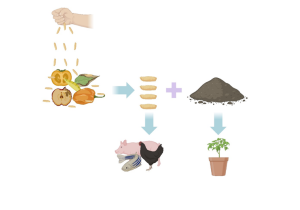
The industrial rearing of the bioconverter insect Hermetia illucens L. (Diptera: Stratiomyidae) is rapidly expanding for two main reasons: the search for new protein sources for animal feed and the need to dispose of an increasing amount of by-products from various industrial sectors. Particularly intriguing is the ability to rear these insects on decomposing organic substrates of both plant and animal origin, converting them into larval biomass rich in proteins and lipids. This biomass can be used, depending on the substrate type, in the production of feed, biofuels, and cosmetics. The by-products of rearing this insect include dead adults and pupal exuviae (from which chitin can be extracted and subsequently converted into chitosan), as well as frass. In agriculture, chitosan, with its antifungal, antibacterial, and antioxidant properties, is used as a biostimulant to enhance plant defense mechanisms and regulate metabolic processes. Frass, due to its chemical composition in macro- and micronutrients and its microbiological content, can be utilized in agriculture as an organic fertilizer. The goal is to find uses for the waste products of this insect’s rearing. Chitosan can improve plant health, while frass, in addition to providing essential nutrients, can stimulate growth through the presence of beneficial bacteria.
How my position is funded
PhD Student in Applied Biology, D.M. 351/2022 PNRR-Ricerca.
My motivations
I chose to pursue a PhD because I have always been captivated by the world of research. This journey offers me the unique opportunity to tackle complex problems and develop innovative solutions while collaborating with diverse experts in my field. I am deeply motivated by the desire to enhance my knowledge and make meaningful contributions that can lead to significant discoveries. Completing my PhD will not only be the culmination of my academic journey but also the beginning of a professional career where I aim to apply my expertise in both academia and industry, driving advancements and gaining practical experience.
A day in a PhD student’s life
The typical day usually begins quite early. Upon arriving at the office, the first step is to check for any emails to read or upcoming deadlines. Then, a few hours are dedicated to bibliographic research and reading articles that may be useful for the laboratory activities to be carried out. After the study phase, it’s time to head to the lab to continue with the scheduled activities. Lab work varies in duration, but I prefer when it’s completed by the afternoon.
Lunch, shared with colleagues, is a valuable moment for discussion, during which we talk about the activities carried out and exchange ideas. In the afternoon, if necessary, lab activities started in the morning are completed. Also in the afternoon, it’s useful to have a meeting with the supervisor or research team to discuss the work done and plan the next steps. This discussion allows for reflection on the methods used, the results obtained, and the consideration of alternative approaches.
At the end of the day, it’s important to log any data collected during the lab activities into a spreadsheet (such as Excel), ensuring accurate organization and facilitating future analysis.
My events
INSECTA 2024, POTSDAM (GERMANY)
D. Ianniciello, R. Salvia, C. Scieuzo, M. Triunfo, A. Guarnieri, A. Boschi, R. Rinaldi, A. Franco, G. Lomonaco, A. Dolce, M. Ventura, A. De Bonis, P. Falabella.
Hermetia illucens chitosan for the preservation of fresh cherry tomatoes.
C. Scieuzo, R. Salvia, A. Guarnieri, M. Triunfo, D. Ianniciello, A. Franco, G. Lomonaco, S. Ouazri, F. Giglio, F. De Stefano, A. De Bonis, P. Falabella. Antimicrobial properties of the chitosan of the bioconverter insect Hermetia illucens.
M. Triunfo, A. Guarnieri, D. Ianniciello, G. Lomonaco, M. Rubino, L. Coviello, A. Vitti, M. Nuzzaci, R. Salvia, C. Scieuzo, P. Falabella.
Chitosan from Hermetia illucens: an innovative and sustainable coating for strawberry preservation.
R. Salvia, C. Scieuzo, M. Triunfo, A. Guarnieri, D. Ianniciello, A. Franco, G. Lomonaco, E. Derin, A. Dolce, M. Ventura, A. De Bonis, P. Falabella.
Hermetia illucens chitosan for the preservation of fresh fruits.
My publications
Lomonaco, G., Franco, A., De Smet, J., Scieuzo, C., Salvia, R., & Falabella, P. (2024). Larval Frass of Hermetia illucens as Organic Fertilizer: Composition and Beneficial Effects on Different Crops. Insects, 15(4), 293.
This comprehensive review delves into a comparative analysis of frass derived from larvae fed on different substrates. The following factors are taken into account: the percentage of dry matter, pH levels, organic matter content,electrical conductivity, moisture levels, and the makeup of macro- and micronutrients. Additionally highlighted is the impact of various feeding substrates on the prevalence of possibly helpful bacteria for plant growth within the frass. In order to emphasize the agricultural advantages and disadvantages of incorporating Hermetia illucens frass into cultivation operations, this paper critically examines the beneficial effects of frass on crops after application. This review’s classification of the crops under study into discrete groups is one noteworthy aspect that will help future research comparisons.