

Brigida Della Mura
Without data, you are just another person with an opinion.” – A. Schleiche
Contact: brigida.dellamura@unibas.it
The development of eco-friendly methods to increase biomass production while reducing the use of chemical pesticides and synthetic fertilizers is one of the most challenging goals for improving the sustainability of future agriculture.
Plant growth-promoting microorganisms (PGPMs) are a promising biotechnological tool as they are known to be beneficial for plant health and biomass production. PGPMs enhance plant resistance to pests and diseases, improve nutrient uptake by plants, and have a positive impact on yield and plant-based productions.
Bacillus subtilis [(Ehrenberg) Cohn] is a Gram-positive, non-pathogenic, widespread bacterium belonging to the group of Plant Growth-Promoting Rhizobacteria (PGPRs). It has shown great potential as a biocontrol agent in agriculture due to the production of a wide range of secondary metabolites, such as lipopeptides.
Currently, only 4 strains of B. subtilis are listed in the EU Pesticides Database, with only 1 strain (B. subtilis IAB/BS03) approved for use in biological control.
There is limited data about the growth of B. subtilis on agro-industrial waste for producing bioactive metabolites useful for plant protection and production.
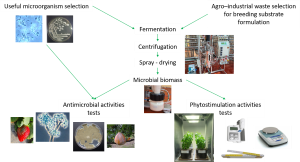
To achieve the goal of obtaining substances with anti-pathogenic action as alternatives to synthetic plant protection products, along with developing a scalable production process for substances with anti-pathogenic and biostimulating activities, it is necessary to select the best B. subtilis strain for bioactive metabolite production, study the optimal operating conditions for the bacterium's growth, as well as determine the best formulation of agro-industrial substrates and any required pre-treatment. It is also crucial to evaluate the antibiotic activity of the metabolites produced against different pathogens and their stimulating effect on crops of interest.
How my position is funded
My PhD scholarship is funded by ENEA (National Agency for New Technologies, Energy and Sustainable Economic Development) under the AGRITECH (National Center for Technology in Agriculture) Spoke 8. This project aims to develop new models of circular economy in agriculture through waste valorisation and recycling. Specifically, I am working on WP 8.3, which focuses on nutrient and organic matter recovery from wastes to reduce the use of agrochemicals and close the waste cycle. Within WP 8.3, I am involved in Task 8.3.3, which is centred on the production of biological-based organic fertilisers from waste to improve biological soil fertility (Spokes - Agritech Center).
My motivations
I have decided to pursue a PhD because I am deeply fascinated by the world of research. I believe that obtaining a PhD will provide me with valuable experience not only in the field of research but also in everyday life. Upon completing my degree, my goal is to find a position that allows me to continue studying and hopefully discover effective alternatives to pesticides and synthetic fertilizers. I am also eager to collaborate with a wide range of professionals in order to further develop and enhance my skills.
A day in a PhD student’s life
In my experience, there is no typical day as a PhD student, and I find this variability fascinating. My thesis allows me to engage in various procedures, resulting in different activities each day based on the ongoing experiment. Some days are spent entirely on the computer for meetings, writing publications, conducting bibliography research, and so on. Other days involve breeding bacteria in Petri dishes, flasks, or fermenters while testing their biocontrol activities against phytopathogens. Additionally, I may need to breed plants under ventilated lamps to evaluate the biostimulating effects of microbial biomass. When in the lab, my first task is to create a to-do list for the day to prioritize and keep track of my activities.
My events
“Lincei per la Scuola” - Dall'invenzione della carta all'iPhone: Come le nanotecnologie hanno cambiato il mondo (31/03/2023).
“Lincei per la Scuola” - Materiali per la Medicina (17/04/2023).
“Lincei per la Scuola” - Motori molecolari: realtà o fantascienza? (21/04/2023).
“Lincei per la Scuola” - Nanotecnologie per la medicina di precisione (28/04/ 2023).
Seminar 14/04/2023 “Esplorare la complessità: Energia, risorse e ambiente”
Seminar 19/05/2023: “Esplorare la complessità: 2 – Complessità, informazione, entropia: tra ‘cosmos’ e linguaggio.”
Seminar 06/06/2023: “Esplorare la complessità: 4 – Cosa sappiamo del cancro e come possiamo sconfiggerlo.”
Seminar 12/06/2023: “Esplorare la complessità: 5 - I sistemi multi-agente in Robotica”
Seminar 05/04/2023: “TRPM8 come target polivalente nel trattamento di disordini del sistema nervoso e malattie tumorali”
Seminar 19/04/2023: “Classici e più recenti bersagli molecolari per il trattamento del COVID 19”
Seminar 27/04/2023: “Target innovativi nella lotta contro il tumore”
Seminar 11/05/2023: “Recettori CB2 ed epossido idrolasi solubile come efficaci target nell'infiammazione”
Seminar 27/10/2023: “Recent advancements in the study of microbial strains of human origin (molecular and non-molecular based methods, MALDI-TOF, IR-spectroscopy). Applications for identification, typing and evaluation of pathogenicity features.”
Seminar 27/11/2023: “Isolation, cultivation, preservation and characterization of bacteria, fungi, viruses: microbial-based biotechnological solutions (MBBS) in agri- food, environmental, cultural heritage, energy and pharmaceutical fields”
Seminar 28/11/2023: “Isolation, cultivation, preservation and characterization of bacteria, fungi, viruses: microbial-based biotechnological solutions (MBBS) in agri- food, environmental, cultural heritage, energy and pharmaceutical fields”
Seminar 15/01/2024: “Growth of microalgal species: Influence of growth parameters, analytics and case studies”
Seminar 16/01/2024: “Growth of microalgal species: Influence of growth parameters, analytics and case studies”
Seminar 23/01/2024: “Isolation and Identification of plant pathogens based on biological and molecular techniques.”
Seminar 26/01/2024: “Recent advancements in the study of microbial strains of animal origin (molecular and non-molecular based methods). Applications for identification, typing and evaluation of resistance phenomena and pathogenicity features.”
Seminar 05/02/2024: “Metodi di caratterizzazione delle microalghe e tecnologie estrattive di composti bioattivi.”
Seminar 06/02/2024: “Metodi di caratterizzazione delle microalghe e tecnologie estrattive di composti bioattivi.”
Seminar 07/02/2024: “Metodi di caratterizzazione delle microalghe e tecnologie estrattive di composti bioattivi.”
Seminar 26- 27/02/2024: “Application of metagenomic approaches to assess food quality and safety.”
“Lincei per la Scuola” - Naturale e sintetico: una versione contemporanea dello Yin e Yang (01/03/2024).
Mirri Training course 07-08/03/2024: “Applicative aspects in the management of bioreactors in fermentation processes: scaling-up of the production of microbial biomass from the laboratory to the pilot plants.”
“Lincei per la Scuola” - Le sostanze naturali quali biopesticidi: un’alternativa per ridurre l’impatto ambientale generato dall’uso massivo dei pesticidi di sintesi (22/03/2024).
Seminar 25/03/ 2024 “Chemorecezione e sviluppo di biosensori innovativi e relative applicazioni.”
“Lincei per la Scuola” - Aromi e Fragranze: Natura e Sintesi Chimica a Confronto (12/04/2024).
Seminar 15/04/ 2024 “Chemorecezione e sviluppo di biosensori innovativi e relative applicazioni.”
Mirri Training course 18/04/2024: “Il biofilm batterico: struttura, caratteristiche, effetti e metodi di controllo – UniVR.”
“Lincei per la Scuola” - Esperienza didattica – nel nome Elais: dall’olio di olivo agli oli essenziali (19/04/2024).
“Lincei per la Scuola” - Aromi naturali e artificiali nell’industria alimentare (03/05/2024).
Seminar 07/05/2024: “Tendenze e Prospettive Emergenti Nell’Ambito di Applicazioni Sostenibili per l’Ingegneria Tissutale e la Medicina Rigenerativa.”
“Lincei per la Scuola” – Riunione conclusiva (10/05/2024).
Seminar 21/05/2024: “Electronic noses and their application.”
Agritech: Coltivare innovazione per un Futuro Sostenibile'' – September 2024, Milan. B. Della Mura, A. Ambrico, M. Trupo, R. A. Magarelli, S. Palazzo, L. d’Aquino. Evaluation of the phytostimulant activity of microbial biomass containing Bacillus subtilis (POSTER) (Innovation in service of the Circular Economy: Agritech Spoke 8 - Poster - Agritech Center).
Agritech: Le sfide dell'economia circolare in ambito agroalimentare. September 2023, Milan. M. Trupo, R.A. Magarelli, M. Martino, V. Larocca, B. Della Mura, A. Ambrico. Utilization of suitable microorganisms for production of substances with antimicrobial effects from agro-industrial waste. (POSTER) (Agenda evento - poster + tavolo definitiva (agritechcenter.it)).
My publications
d’Aquino, L., Cozzolino, R., Malorni, L., Bodhuin, T., Gambale, E., Sighicelli, M., Della Mura, B., Matarazzo, C., Piacente, S., & Montoro, P. (2024). Light flux density and photoperiod affect growth and secondary metabolism in fully expanded basil plants. Foods, 13(14), 2273. https://doi.org/10.3390/foods13142273
Indoor production of basil (Ocimum basilicum L.) is influenced by light spectrum, photosynthetic photon flux density (PPFD), and the photoperiod. To investigate the effects of different lighting on growth, chlorophyll content, and secondary metabolism, basil plants were grown from seedlings to fully expanded plants in microcosm devices under different light conditions: (a) white light at 250 and 380 μmol·m−2·s−1 under 16/8 h light/dark and (b) white light at 380 μmol·m−2·s−1 under 16/8 and 24/0 h light/dark. A higher yield was recorded under 380 μmol·m−2·s−1 compared to 250 μmol·m−2·s−1 (fresh and dry biomasses 260.6 ± 11.3 g vs. 144.9 ± 14.6 g and 34.1 ± 2.6 g vs. 13.2 ± 1.4 g, respectively), but not under longer photoperiods. No differences in plant height and chlorophyll content index were recorded, regardless of the PPFD level and photoperiod length. Almost the same volatile organic compounds (VOCs) were detected under the different lighting treatments, belonging to terpenes, aldehydes, alcohols, esters, and ketones. Linalool, eucalyptol, and eugenol were the main VOCs regardless of the lighting conditions. The multivariate data analysis showed a sharp separation of non-volatile metabolites in apical and middle leaves, but this was not related to different PPFD levels. Higher levels of sesquiterpenes and monoterpenes were detected in plants grown under 250 μmol·m−2·s−1 and 380 μmol·m−2·s−1, respectively. A low separation of non-volatile metabolites based on the photoperiod length and VOC overexpression under longer photoperiods were also highlighted.