

Francesca Armiento
“Transforming natural polymers into advanced biomaterials for cutting-edge tissue regeneration.”
Contact: Francesca.armiento@unibas.it
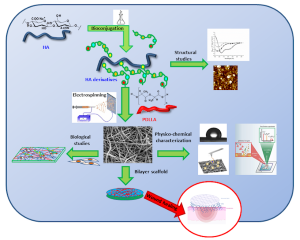
The PhD project "Bi-hyaluronic: Hyaluronic acid-inspired biomaterials" aims to develop hydrogels and electrospun matrices of hyaluronic acid (HA) conjugated with bioactive molecules, such as natural L-amino acids and elastin peptides, to promote tissue regeneration in injury repair. The electrospun hybrid will be crosslinked to create a 3D matrix. While there are examples of HA and bioactive peptide conjugates in the literature, none have been electrospun due to the high viscosity of HA solutions. This fundamental research underpins the future development of innovative, environmentally friendly additive manufacturing technologies utilizing biopolymers like HA and elastin. The electrospinning process will produce nanofibrous membranes mimicking the extracellular matrix (ECM) of tissues, facilitating cellular processes. The project involves peptide synthesis and purification, conjugation with HA, electrospinning technology, UV crosslinking, and characterization of the resulting matrices. Techniques include SEM, TEM, ATR, FTIR, and XRD. Additionally, the project will involve industry collaboration and international research phases to finalize the development of medicated patches with biodegradable and biocompatible properties. The technical feasibility relies on expertise in biopolymer conjugation chemistry and electrospinning for biomedical applications.
How my position is funded
My PhD project is funded by an INPS grant titled "Bi-hyaluronic: Hyaluronic acid-inspired biomaterials." This project is focused on developing new biomaterials inspired
My motivations
I chose to pursue a PhD in chemistry to bridge my background in biotechnology with my growing interest in chemistry. My studies in biotechnology provided me with a strong foundation in biological applications and systems, but I wanted to deepen my knowledge in chemistry, particularly in the synthesis and characterization of bioactive materials.
My PhD project, "Bi-hyaluronic: Hyaluronic Acid-Inspired Biomaterials," perfectly combines these fields. It involves developing advanced biomaterials based on hyaluronic acid conjugated with bioactive molecules, aligning with both my biotechnological expertise and my interest in chemical processes.
After earning my PhD, I aim to continue in academia or industry, where I can integrate my skills in biotechnology and chemistry. I look forward to tackling challenging problems and contributing to innovative solutions in medicine and biotechnology, leveraging my interdisciplinary knowledge to advance scientific progress.
My typical PhD day begins at 9 AM when I arrive at the “BioInspired Materials Laboratory.” I start by setting up and monitoring bioconjugation reactions between hyaluronic acid and amino acids or peptides. This involves preparing the reaction mixtures, carefully controlling the conditions, and analyzing the results. After the reactions are completed, I focus on purifying the resulting bioconjugates.
On some days, instead of working on bioconjugation, I dedicate my time to electrospinning the purified bioconjugates. Electrospinning is a key process in my project, as it allows me to create nanofibrous matrices that are essential for developing advanced biomaterials. This involves optimizing parameters such as polymer concentration, voltage, and flow rate to achieve the desired fiber morphology.
Each day can vary depending on the phase of the project, but my routine is centered around these core activities, which are crucial for advancing my research and achieving my project's goals.
Currently, I have not had the opportunity to participate in seminars or conferences related to my field. However, I am actively seeking opportunities to engage in such events in the near future. I believe that attending these events will be invaluable for my professional development and for sharing my research with the broader scientific community. I am particularly interested in participating in upcoming conferences and workshops that focus on biomaterials, tissue engineering, and electrospinning technologies, as these align closely with my research interests and goals. I am hopeful that I will be able to take part in these events soon and look forward to contributing and learning from the scientific community.
My publications
- Title: A Study on Thiol-Michael Addition to Semi-Synthetic Elastin-Hyaluronan Material for Electrospun Scaffolds
Authors: Antonio Laezza, Antonietta Pepe, Nicola Solimando, Francesca Armiento, Floriane Oszust, Laurent Duca, Brigida Bochicchio
Thiol-Michael addition is a chemical reaction extensively used for conjugating peptides to polysaccharides with applications as biomaterials. In this study, a chemical strategy was developed for the semi-synthesis of a hyaluronan-elastin conjugate containing an amide linker (ELAHA) using tris(2-carboxyethyl)phosphine hydrochloride (TCEP • HCl). The bioconjugate was electrospun with poly-D,L-lactide (PDLLA), resulting in scaffolds with promising characteristics in terms of morphology and dermal fibroblast cell viability. To understand the factors influencing the efficiency of the bioconjugation reaction, thiolated amino acids were also investigated as nucleophiles towards hyaluronan decorated with Michael acceptors in the presence of TCEP ⋅ HCl by evaluating the formation of byproducts.
- Title: Chemical Modifications in Hyaluronic Acid-Based Electrospun Scaffolds
Authors: Antonietta Pepe, Antonio Laezza, Francesca Armiento, Brigida Bochicchio
Hyaluronic acid (HA) is a natural, non-sulfated glycosaminoglycan (GAG) present in the extracellular matrix (ECM). It plays various biological roles and has appealing properties in cosmetics, pharmaceuticals, and tissue engineering. HA is commonly electrospun with natural or synthetic polymers to produce fibers with nano- and micro-scale diameters, which can host cells for tissue regeneration. Recent literature has extensively explored electrospun HA-based materials. Chemical modifications are often introduced to facilitate crosslinking or conjugation with bioactive molecules. Given HA's high water solubility, crosslinking is crucial to enhance stability in biological fluids and to prevent HA release when implanted in vivo. Additionally, conjugation with bioactive molecules is reported to endow HA-based scaffolds with new chemical or biological properties. This review categorizes chemical modifications on HA and HA-based electrospun fibers into: i) in-situ crosslinking, ii) off-site crosslinking, and iii) conjugation with biofunctional molecules, focusing on peptides.