

Padula
“A journey at the interface between environmental sustainability and applied biotechnology.”
Contact: francesca.padula@unibas.it
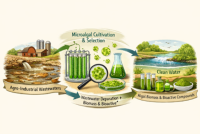
The increasing scarcity of freshwater resources and the continuous growth in agro-industrial wastewater production represent one of the major environmental and socio-economic challenges worldwide. Wastewaters generated by agro-food supply chains are often characterized by high organic loads, nutrients such as nitrogen and phosphorus, phenolic compounds, microplastics, and other potentially toxic substances. Inadequate treatment or reuse of these matrices poses serious risks to human health and ecosystems, while conventional treatment systems are often energy-intensive, costly, and environmentally unsustainable. Within this framework, the aim of this PhD project is to develop an innovative and sustainable system for the bioremediation and valorization of agro-industrial wastewaters using microalgae. The main objective is to select and engineer robust microalgal lines capable of growing efficiently on real wastewater matrices while combining high depuration efficiency with biomass production and the synthesis of high-value bioactive compounds. The project relies on the use of selected microalgal species known for their robustness, metabolic flexibility, and relevance as biological models, and includes innovative approaches such as somatic hybridization and the generation of a microlibrary of mutants adapted to specific selective pressures. The obtained strains are tested on wastewaters, which are characterized from a chemical-physical, microbiological, nutritional, and ecotoxicological perspective. Experimental activities include liquid and solid culture systems, growth curve analysis, stress tolerance evaluation, DNA and RNA extraction for genetic and gene-expression studies, and functional validation of the bioactive compounds produced. The expected outcome of this project is the development of an integrated circular-economy model that combines sustainable wastewater treatment, environmental impact reduction, and the production of microalgal biomass suitable for environmental, nutraceutical, and industrial applications.
How my position is funded
My PhD position is funded within the framework of the Italian National Recovery and Resilience Plan (PNRR) and is carried out as an industrial PhD in collaboration with a Bioinnova srle. This funding scheme aims to strengthen the connection between academic research and the industrial sector, promoting innovation, technology transfer, and the development of sustainable solutions with direct socio-economic impact. The project is therefore embedded in a broader research and innovation framework that integrates academic expertise with industrial needs, allowing the research outcomes to be oriented toward real-world applications while maintaining a strong scientific foundation.
I decided to pursue a PhD driven by a strong interest in environmental sustainability and applied biotechnology, and by the desire to deepen my scientific knowledge through independent and critical research. During my academic training, I developed a particular interest in biological systems capable of offering concrete solutions to complex global challenges. The PhD represents for me an opportunity to actively contribute to the generation of new knowledge, bridging fundamental research and real-world applications. Through this doctoral path, I aim to acquire advanced experimental, genetic-molecular, and biofunctional skills, as well as to strengthen my critical thinking, problem-solving abilities, and scientific project design. After obtaining the PhD degree, I plan to continue my career in research, either in academia or industry, contributing to the development of innovative and sustainable solutions with tangible environmental and societal impact.
A typical day during my PhD is largely shaped by experimental work in the laboratory. A significant portion of my time is dedicated to microalgal cultivation, monitoring growth curves, and managing agro-industrial wastewaters used as alternative nutrient sources. Daily activities include culture medium preparation, cell counting, spectrophotometric analyses, and plating and re-plating procedures to isolate pure and adapted microalgal lines.Alongside laboratory work, an essential part of my day is devoted to data analysis, literature review, and experimental planning. Regular meetings with supervisors provide opportunities to discuss results and define new experimental strategies. The PhD experience also includes participation in courses, seminars, and training activities, which contribute to the development of both technical and transferable skills. While each day brings different challenges, all share a balance between experimentation, critical analysis, and continuous professional growth.
Agriworld Expo 2025, Matera (May 22–23, 2025) – Poster presentation presenting preliminary results of the PhD project.
Participation in PhD training courses and scientific seminars focused on experimental methodologies, data analysis, and environmental sustainability.
My publications
Research article on the role of microalgal antioxidant molecules in the modulation of the gut microbiota–intestine axis in inflammatory bowel diseases. The study explores the potential of microalgal biomolecules as functional agents with nutraceutical applications.
Review article on the role of microalgae in carbon sequestration and environmental sustainability. The review provides a critical overview of microalgal strategies for climate change mitigation and the development of sustainable systems.