

Michela Marsico
“The PhD was an exciting journey between research and discovery, with its ups and downs, where each obstacle overcome made the taste of success sweeter.”
Contact: michela.marsico@unibas.it
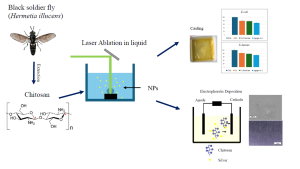
My PhD project focuses on the production of a composite material with strong antimicrobial properties using green techniques. More specifically, it is a nanocomposite biopolymer, the components of which are chitosan, from an alternative source to marine, Hermetia illucens, and nanoparticles, such as copper and silver; the individual components, Chitosan, AgNPs and CuNPs have antibacterial properties, the aim of the project is to evaluate a possible synergy of action once they are combined with the polymer and metal parts. The technique chosen for the production of composite material is laser ablation in liquid, the technique has advantages such as: possibility to work at ambient temperature, production of particles directly in the polymer matrix without residues of reagents that pollute the surface of nanoparticles.
How my position is funded
My doctoral scholarship is funded by the Basilicata region
My motivations
At the end of my degree I decided to continue my studies and obtain a PhD for several reasons; on the one hand, during the experimental thesis I was able to get to know the world of research and I am very passionate about it, The PhD allows for in-depth research into a particular field and topics, so that it can potentially contribute to the development of knowledge through new discoveries. The PhD, on the other hand, also allows to develop advanced technical and analytical skills, using devices, as well as problem-solving and critical thinking skills, these skills are also appreciated in industrial sectors as well as in strictly academic fields. One less known but very stimulating aspect of the PhD is the possibility to get in touch with experts and colleagues in your field, attend conferences and seminars, or even collaborate with other researchers at international level; such interaction certainly allows for professional but also personal growth and the networking created during the PhD could be valuable for future career opportunities. Finally, a further push to the choice of doctorate is derived from the desire to contribute in some way to society, research specifically in the scientific-medical field can potentially lead to solutions to some problems that afflict the population, Leading to a general improvement in the lifestyle. At the end of this course, I would like to work in the research and development sector of companies, preferably operating in the pharmaceutical field.
A day in a PhD student’s life
My typical laboratory day can vary greatly depending on the phases of the project or the need to attend seminars, workshops or lectures if scheduled. Once you get to the lab, you often start by reviewing your day’s work plan. This may include consulting the laboratory journal, reviewing data collected in previous days and planning experiments to be performed. Then, the most practical part of the work, namely the preparation of experiments, is carried out; solutions, reagents and the necessary materials for the experiments are prepared; Set-up of the necessary instruments and laboratory equipment and finally consult protocols and scientific papers to ensure that all procedures are followed correctly. In the early afternoon, either the planned experiments are carried out or experiments already under way are monitored and the data obtained recorded. Once collected, the data is analyzed using specific software. This may include statistics or data visualization. Finally, the data are interpreted to understand whether experiments have confirmed the original assumptions or if further investigation is necessary. Usually in the experimental waiting times we are busy either updating the laboratory diary, so that we have an accurate record of everything that has been done or writing scientific articles or theses. Writing may include reviewing literature, writing method and result sections, and preparing graphs and figures.
My events:
3rd International Conference BioMaH - Biomaterials and Novel Technologies for Healthcare Rome from 8-21 October 2022
Poster titled:
Chitosan-metal nanoparticles composite with enhanced antibacterial activity, M. Marsico ,M. Curcio , A. Galasso , P. Falabella , M. Triunfo , A. Guarnieri , R. Salvia , C. Scieuzo , D. Ianniciello , R. Teghil , A. De Bonis.
Chitosan-metal nanocomposite with enhanced antibacterial and photocatalytic activity obtained by laser ablation in liquid, M. Marsico ,M. Curcio , A. Galasso , A. Santagata, P. Falabella , M. Triunfo , A. Guarnieri , R. Salvia , C. Scieuzo , D. Ianniciello , R. Teghil , A. De Bonis.
EMRS 2024 Spring Meeting, Strasbourg (France) from 27-31 May 2024
Poster title: Evaluation of biocompatibility and antimicrobial activity of electrophoretic deposited chitosan: exuvial chitosan and chitosan-silver nanoparticles, M. Marsico , M. Curcio , A. Galasso, P. Falabella, A. Guarnieri, R. Salvia, C. Scieuzo, D. Ianniciello ,R. Teghil, A. De Bonis.
Poster title: Antimicrobial and cytocompatible silver nanoparticles-chitosan composite material, obtained by laser ablation in liquid, M. Marsico, M. Curcio, A. Galasso, P. Falabella, A. Guarnieri, R. Salvia, C. Scieuzo, D. Ianniciello ,R. Teghil , A. De Bonis.
My publications
Michela Marsico, Rezvan Azari, Mariangela Curcio, Roberto Teghil, Micaela Triunfo, Patrizia Falabella, Aldo Roberto Boccaccini and Angela De Bonis
Enhancing the Antibacterial Properties of Chitosan Coatings: Ag@Chitosan and Chitosan from Insects
Coatings 2024, 14(8), 925 https://doi.org/10.3390/coatings14080925
In the work, the use of Hermetia illucens chitosan and the composite material, Chitosan-AgNPs, obtained by laser ablation in liquid, as a starting material for the coating of bone implants was evaluated. The technique used for forming coatings is electrophoretic deposition, which allows to obtain homogeneously distributed and resistant deposits, which have demonstrated antibacterial activity against gram-positive and gram-negative bacteria and biocompatibility on the MG-63 osteoblast cell line.