

Santopietro federica
“Exploiting the neuroprotective properties of medicinal mushrooms to provide a scientific solution to mental fatigue.”
Contact: federica.santopietro@unibas.it
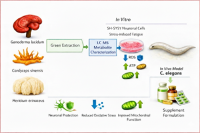
Mental fatigue is a pervasive and debilitating condition in modern society that significantly impairs cognitive performance, productivity, and quality of life. Despite its prevalence, there is a critical lack of specific pharmacological treatments devoid of side effects. In this context, medicinal mushrooms emerge as a powerful solution. My doctoral research focuses on Ganoderma lucidum (Curtis) P. Karst. (Reishi), Cordyceps sinensis Berk., and Hericium erinaceus (Bull.) Pers. (Lion’s Mane). These mushrooms are particularly suitable for solving this problem, as they have significant neuroprotective activity and contain specific bioactive metabolites capable of exerting anti-fatigue effects. Unlike synthetic drugs, these natural compounds can restore physiological balance and protect neuronal integrity by acting directly on the causes of fatigue. To scientifically validate this potential, I will use sustainable green extraction methodologies (ultrasound-assisted techniques) to optimise the yield of these key metabolites, which will be characterised by LC-MS. Next, I will evaluate their effectiveness in vitro neuronal stress models (SH-SY5Y cells) by assessing cell viability (MTT test), oxidative stress (ROS production) and mitochondrial function (ATP production). Once the model has been validated, it will be possible to evaluate it on in vivo models. The ultimate goal is to develop effective supplements that harness the natural power of these mushrooms to combat fatigue and promote neuroprotection.
My PhD position is part of the PNRR project in collaboration with the company “Veronatura srl”. In particular, it is part of the Ministerial Decree 630/2024 with the aim of evaluating new phytotherapeutic products and their impact in experimental models for health applications.
My motivations
My decision to pursue a PhD was driven by the passion for research that I developed during my experimental master's thesis and my research traineeship abroad. These experiences broadened my scientific horizon and reinforced my belief that a PhD was the necessary step to acquire the advanced tools required to work in research. It is truly inspiring to have the opportunity to apply rigorous scientific methods to study how nature can solve modern health challenges such as mental fatigue. As for my expectations after graduation, I aspire to continue working in research and development (R&D), most likely in the pharmaceutical or nutraceutical industry. My goal is to contribute original insights that bridge the gap between basic science and practical application, helping to develop innovative, scientifically proven products that improve quality of life.
A day in a PhD student’s life
My typical PhD day begins at university with a coffee shared with my colleagues. This daily meeting is more than just a break: it's a valuable opportunity to exchange ideas, discuss experimental challenges, and start the day in harmony. The morning is then mainly dedicated to laboratory activities, the central part of my research. This part of the day I focus on maintaining and carefully monitoring my SH-SY5Y cell cultures, a task that requires precision and attention. Once the cells are checked, I proceed with the experiments, treating the samples with fungal extracts after being subjected to stress models. In the afternoon, the focus is on data analysis and critical evaluation of experimental results. I also spend a lot of time researching the literature, studying the latest scientific literature to accurately interpret my findings and plan future phases of the project.
My events
- Benedetto, N., Lela, L., Santopietro, F., Russo, D., Milella, L.. Effect of Vitis vinifera L. cv Aglianico by-products on lipid metabolism in 2D and 3D-cultured 3T3-L1 cells. Workshop "ADVANCED SKILLS IN SUSTAINABLE RESEARCH-Interdisciplinary Advances in Natural Products Research:From Ecosystems to Molecular Targets, 23-24 Settembre 2025, Villa Ferretti, Bacoli (NA), Italia (ORAL).
- Tuseef, M., Carlucci, V., Faraone, I., Benedetto, N., Santopietro, F., & Milella, L.. Optimization of bioactive compounds extraction from common bean (Phaseolus vulgaris L.) pods using response surface methodology. ISSNP, 29 Giugno - 4 Luglio 2025, Torre del Greco (NA), Italia (ORAL).
- Santopietro, F., Benedetto, N., Russo, D., Tuseef, M., Mangieri, C., Carmosino, M., Milella, L.. Echinacea angustifolia DC. root extract: phytochemicals and molecular mechanisms in wound healing. 2° Congresso intersocietà sui prodotti vegetali per la salute: Il ruolo delle piante medicinali nella medicina moderna 10-12 Aprile 2025, Napoli, Italia (ORAL).
- Santopietro F., Accardo M., Faraone I., Radice R. P., Martelli G., Vassallo A.. Nanoformulations based on Pistacia vera L. with immunomodulatory activity, Workshop SIF YOUNG TO YOUNG: TODAY FOR TOMORROW, Camogli, 27-28 September 2024 (Poster).
- Carlucci V., Ponticelli M., Lela L., Mangieri C., Santopietro F., Faraone I., Russo D., Milella L.. Response Surfase Methodology as a tool to obtain a potential satiating bitter enriched ecxtrat from Gentiana lutea L., International Congress on Natural Products Research, Kraków, 2024 (Poster).
- Lela L., Benedetto N., Ponticelli M., Mangieri C., Kioussi C., Stevens J.F., Santopietro F., Tzvetkov N.T, Milella L.. HUMULUS LUPULUS L. PHYTOCHEMICALS, DOCKING AND OBESITY: DO BITTER ACIDS PLAY A BENEFICIAL ROLE?, 25th Conference on Isoprenoids, Naples, 18-20 September 2024 (ORAL).