

Ian Abdallah
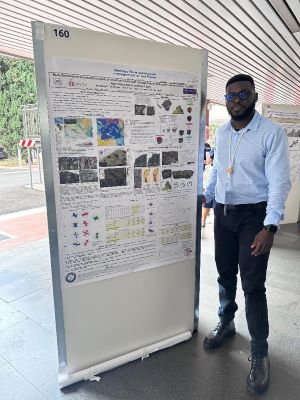
“Phew!!!”
Contact: ian.abdallah@unibas.it
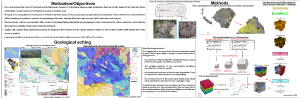
Faults can have a profound influence on the accumulation and migration of fluids in the shallow crust. Due to their conductive, sealing, and/or combined fluid barrier-conduct behaviour, faults impact the subsurface hydrogeology according to the processes associated with their nucleation and growth, the geometry of the interacting fault segments, the strain rates they evolved under, the tectonic environment in which they formed, and their diagenetic history. In this study, we carried out a structural survey on cliffs several 100’s metres high exposing Jurassic–Cretaceous platform carbonates crosscut by WNW-striking, high-angle trans-tensional faults bounding theHigh Agri Valley Basin. By combining field and digital outcrop structural analysis techniques, we assessed the variation of geometry, distribution, density, and intensity of both fractures and faults according to the host rock lithology and distance from the main basin-bounding faults. Then, we computed their multiscale length and height attributes to obtain input data for Discrete Fracture Network (DFN) modelling and fluid flow simulation. For the DFN modelling, we built multiple stochastic models of fracture networks at bed package (height: 5m),outcrop (height: 50m) and reservoir scales (height: 500m). Our goal is the assessment of variations of both bulk fracture porosity and permeability, as well as the scaling factors for horizontal permeability ellipses. Finally, we carried out a fluid flow simulation of the whole Monte Viggiano area in order to understand the behaviour of the carbonate aquifer at varying boundary conditions. Field and digital results show a scale dependency of fracture and fault geometry over 3-orders of magnitude for the Cretaceous carbonates, and, in contrast, a scale independent geometry for the Jurassic carbonates. In terms of fluid storage and migration properties, results from the DFN modelling show the profound contribution provided by both strata-bound and non-strata-bound fractures to the computed porosity, and by faults to the computed permeability. Furthermore, most of the DFN models show near isotropic horizontal permeability ellipses, which is consistent with the fractured and faulted carbonates behaving as a porous medium for horizontal fluid flow. We note that fault-parallel dominated flow is exhibited by geocellular volumes representative of the main basin-bounding fault zones. Results of ongoing fluid flow simulation should shed more light on the optimum reservoir development and production strategy to adopt while modelling the migration of fluid through the assessed pathways. Overall, the results of this study will be useful to hydrogeologists for groundwater management and operations, and to other geoscientists and reservoir engineers in understanding shallow reservoir behaviour, identifying production/injection patterns, and optimizing reservoir management strategies.
How my position is funded
Programma Operativo Nazionale Ricerca e Innovazione 2014-2020 (CCI 2014IT16M2OP005), risorse FSE REACT-EU, Azione IV.4 “Dottorati e contratti di ricerca su tematiche dell’innovazione” e Azione IV.5 “Dottorati su tematiche Green”
Project: Fluid Storage and Migration Properties of Fractured and Karstified Carbonate Aquifers
My motivations
My interest in naturally fractured carbonate reservoirs is one of the motivating factors to the application of this role. More than 50% of the world oil and gas has been produced from carbonate reservoirs (Qiang, Z, 2007; Roehl and Choquette., 2012) and the water supply for approximately 25% of the world population are produced from carbonate aquifers (Chen et al., 2017). Also, extensive research is being carried out on carbonates, for future capture and storage of carbon (CCS) and hydrogen sustainable energy projects. Apparently carbonate rocks are essential for human development and indeed global interest in carbonate rocks are increasing by the day.
Our work, in my master thesis, opened my eyes to many areas in which geological problems can be solved, especially by integrating “state of the art” techniques and technologies which incorporate computer software packages. These technologies are developed and modified by altering source codes for example, in the python code used to generate the geo-trace plugin used in QGIS for fracture extraction (structural analysis) (Abdallah et al., 2021) or the embedded C codes used in FracPaQ ® (Healy et al., 2017) to serve the same purpose, saving the geologist time and resources in carrying out structural analyses especially in difficult terrains. Now imagine the world without the collaboration between geoscientists, software engineers and engineers.
Also, haven studied and analysed the physical and stratigraphic properties of a well exposed carbonate outcrop in south eastern Cyprus, one of my concluding recommendations was the performance of Discrete fracture Network (DFN) Modelling for more detailed results; this PhD work gives me the opportunity to continue a work very similar to my Master thesis and to gain more insight into the porosity and permeability properties of carbonates especially as it applies to solving complex problem of protection and exploitation of depleting ground water resources.
My expectation after this programme is to apply the knowledge I acquired during my MSc/PhD and machine learning techniques to incorporate karst-related apertures in carbonate reservoir/aquifer computations preferably at a research institute or a company.
A day in a PhD student’s life
Resume work by 8am, take coffee, morning meeting by 8:30 or 9:00, almost every day.Head to the modelling laboratory or office to work on the computer. Other days are spent in the field gathering data relating to the project. Afternoon update meetings by 15.30. Close by average 18:00 on less busy days.
My events
This includes attendance in person/online and article submitted and presented by co-authors:
- American Association of Petroleum Geologist (AAPG) workshop – co-author attendance – one poster presentation
- European Geologist Union (EGU) General Assembly June 2023, Vienna, Austria – In person attendance with one poster presentation.
- SGI – SIMP Conference September 2023, Potenza, Italy - two oral presentations and co-chair one fieldtrip - In person attendance.
- Tidalites sedimentology conference 2022, Matera, Italy – In person attendance.
- European Geologist Union (EGU) General Assembly April 2024, Vienna, Austria - one poster presentation and one oral presentation by co-author - in person attendance.
- Yorkshire Geological Society meeting June 2024 titled “Carbonates of the North”, Liverpool, United Kingdom – In person attendance
- TWINN2SET Summer school on Energy Transition in Crete, Greece, July 2024 – Online attendance.
- International Geological Congress (IGC) August 2024 in Busan, South Korea – one oral presentation and one field trip by co-author – In person attendance.
- SGI – SIMP Conference September 2024, Bari, Italy - two poster presentations - In person attendance.
- Scuola Pialli September 2024 tagged, “Geothermal reservoir engineering workshop” in Perugia, Italy – in person attendance.
My publications
- Manniello, C., Abdallah, I. B., Prosser, G., & Agosta, F. (2023). Pressure solution-assisted diagenesis and thrusting-related deformation of Mesozoic platform carbonates. Journal of Structural Geology, 173, 104906.
Depositional and diagenetic processes profoundly control the structural evolution of shallow-water carbonates through time. We focus on the Lower Jurassic platform carbonates pertaining to the southern Apennines fold-and-thrusts belt, Italy, by performing 3D digital outcrop modeling, field structural analysis, and microstructural investigation. Results show that pressure solution of the platform carbonates was affected by the grain size of single beds. Since early diagenesis, pressure solution localized within the coarser-grained carbonate beds, forming wave-like solution surfaces. Crosscutting relations among blocky cements, bed-parallel solution surfaces and high-angle veins show that pressure solution occurred during burial diagenesis with formation of wave-like solution surfaces, and during Late Miocene tectonic burial with formation of seismogram-like solution surfaces. The tectonic burial postdated the thrusting-related flexural slip folding and small-scale thrusting of the platform carbonates. Small scale thrusting took place by means of shearing of the bed-parallel heterogeneities, and formation of bed-oblique slickolites resulting in the development of back thrusts characterized by flat-ramp-flat geometries. The main results of this work are synthesized in a six-stage synoptic scheme reporting the structural evolution of the platform carbonates. Outcomes are helpful for the better assessment of geofluid production/storage from/in fractured platform carbonates pertaining to fold-and-thrust belts.
- Abdallah, I. B., Manniello, C., Prosser, G., & Agosta, F. (2023). Multiscale structural analyses of Mesozoic shallow-water carbonates, Viggiano Mt., southern Italy. Journal of Structural Geology, 176, 104978.
The high-angle faults bounding the High Agri Valley Basin eastwards are well-exposed at the Viggiano Mt., southern Italy. There, these faults crosscut Mesozoic shallow-water carbonates and permit the multiscale analyses of fault and fracture geometry and distribution. Aiming at assessing the control exerted by carbonate lithofacies and scales of observation, we combine field and digital structural analyses to compute the values of 1D and 2D fracture density and intensity, and the dimensional properties of single fault and fracture sets. As a result, from outcrop to reservoir scales we document a scale-variant geometry of faults and fractures, and the great variation of both fracture density and intensity among the studied carbonate lithofacies. Furthermore, we compute a P21 dimensional scaling factor of ca. 20 for over 3 order magnitude, whereas inconsistent results are achieved for the P20 values. Not considering the control exerted by the single carbonate lithofacies, at a reservoir scale we document that the small-scale faults greatly impact the computed P21 values.
- Abdallah, I., Panza, E., Dastoli, S., Manniello, C., Prosser, G., & Agosta, F. (2024). Multiscale Discrete Fracture Network modelling of shallow-water carbonates: East Agri Valley Basin, southern Italy. Marine and Petroleum Geology, 107048.
We investigate the multiscale geometrical and dimensional properties of fracture and fault networks crosscutting Lower Jurassic to Cretaceous shallow-water carbonate rocks. The carbonates are exposed along the flanks of the Viggiano Mt., on the eastern side of the High Agri Valley Basin of southern Italy. Furthermore, we employ the results of field and digital structural analyses to derive the input parameters for subsequent DFN modeling of geocellular volumes whose dimension and architecture resemble those of the investigated sites. DFN modelling is carried out for geocellular volumes representing the studied bed packages (5m-side vols), outcrops (50m-side vols), and reservoir-scale carbonate cliffs (500m-side vols). Notably, modelling is obtained considering the minimum mechanical aperture value obtained in the field for porosity computations and theoretical values of fracture hydraulic aperture for permeability computations. This is because the mechanical aperture values and roughness profiles collected in the field along single fractures are unreliable due to weathering and localized karst-related dissolution. Our findings reveal that a scale-dependent geometry characterizes the Cretaceous carbonates over three orders of magnitude. These results support previously published data, and contrast with those obtained for the Lower Jurassic carbonates, which suffer of some bias due to the quality of the exposures. After DFN modelling, we show that the amount of computed fracture porosity is mainly due to the SB and NSB fractures, and that equivalent permeability is greater within faulted rock volumes. In terms of horizontal permeability, which is the most reliable result after DFN modeling, we document near-isotropic horizontal permeability ellipses at all scales of observations. At individual outcrops, we note that the permeability ellipses are elongated parallel to the dominant fault sets, which denotes how localized strain affects the directionality of fluid flow.