

Valentina Pucciarelli
“The power of insects and the advancement of biotechnology to transform waste into valuable products, towards greener energy”
Contact: valentina.pucciarelli@unibas.it
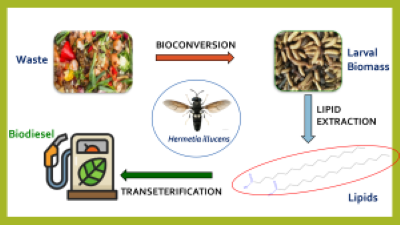
This doctoral project aims to optimize the rearing of the insect Hermetia illucens (BSF, black soldier fly) on unconventional substrates for the bioconversion of organic waste into lipids intended for biodiesel production. This study addresses two globally relevant issues: the ineffective management of waste, which poses a serious environmental, economic, and health threat, and the urgent need to develop sustainable alternative energy sources in the face of depleting fossil resources. Rearing H.illucens on low-value organic waste provides a dual solution by reducing global waste and converting it into lipid-rich larval biomass suitable for energy applications. The project focuses on three main aspects: optimizing H.illucens rearing to maximize lipid production, optimizing lipid extraction processes, and optimizing the transesterification reaction for biodiesel production. The study will examine optimal lipid-to-solvent ratios, reaction temperatures, and times to enhance the efficiency and yield of the produced biodiesel. The production of biodiesel from H. illucens is driven by several scientific and ecological factors, as its rearing offers a significant reduction in environmental footprint compared to traditional livestock farming, requiring fewer water and land resources, and producing substantially lower greenhouse gas emissions. Preliminary studies indicate that biodiesel derived from H.illucens larvae lipids meets European biodiesel standards, with physicochemical properties in line with international regulatory requirements. Moreover, using low-cost waste substrates for larval feeding could reduce biodiesel production costs by up to 70% compared to conventional raw materials, providing an environmentally sustainable and economically competitive solution.
How my position is funded
My doctoral position is funded through the NextGenerationEU Program, specifically under DM 352/2022. This European Union funding supports projects that promote environmental sustainability and technological innovation, aligning with European policies on ecological transition. The doctoral project involves using insects for the bioconversion of by-products from the agro-food chain and other sectors, aiming to produce high-value secondary products, focusing on lipids for biodiesel production. This project aligns with the goals of the National Recovery and Resilience Plan (PNRR), specifically under "Mission 2: Green Revolution and Ecological Transition." It falls within Component 1, "Sustainable Agriculture and Circular Economy," and Subcomponent "M2C1.1 Improving Efficient and Sustainable Waste Management and the Circular Economy Paradigm." Additionally, it contributes to the Subcomponent "M2C2.1 Increasing the Share of Energy Produced from Renewable Sources," which emphasizes strengthening research processes for implementing innovative and sustainable solutions for energy production from renewable sources, such as insects.
For more details on the funding and themes of the doctoral project, please consult this link: https://www.agenziacoesione.gov.it/dossier_tematici/nextgenerationeu-e-pnrr/.
My motivation
I chose to pursue a PhD in Applied Biology to deepen my knowledge and skills in a field crucial for the sustainability of our planet. My undergraduate degree in Biotechnology and my Master's degree in Biotechnology for Medical, Pharmaceutical, and Veterinary Diagnostics have provided me with expertise in both clinical and experimental research, igniting a profound passion for biotechnology and a continuous desire for learning. Currently, the PhD allows me to further expand these competencies and tackle global environmental challenges through the study of biofunctional molecules and the development of innovative solutions in bioconversion and renewable energy. My research project, which focuses on using insects to transform waste into valuable resources, aims to contribute to sustainable technologies and environmentally friendly practices. Through the PhD, I intend to gain solid practical and theoretical experience, essential for addressing global environmental challenges. After this program, I expect to apply and expand the skills acquired by working in academic or industrial settings, and collaborating with institutions and companies to develop sustainable technologies and promote eco-friendly practices. I am motivated to actively participate in research and contribute to environmental protection, hoping to engage with new scientific and cultural realities and make a concrete contribution to the development of effective and sustainable solutions.
A day in a PhD student’s life
My typical PhD day begins early with a review of the planned activities and research objectives for the day. Mornings are primarily dedicated to conducting laboratory experiments, which may include sample analysis, solution preparation, and managing sophisticated equipment. During these times, I focus on data collection and optimizing experimental protocols. On some days, I allocate time to the rearing of Hermetia illucens, a crucial task for the project. This activity involves managing environmental conditions, feeding the insects, and collecting larvae for bioconversion, ensuring that all aspects of rearing are optimized to maximize lipid production. Throughout the day, I also participate in group meetings and discussions with my supervisor, where I review progress, address any issues, and plan the next steps. These moments are essential for receiving feedback and making any necessary adjustments to the research strategy. After lunch, I dedicate time to reviewing scientific literature and analyzing collected data using specialized software for processing and interpretation. Afternoons are often reserved for studying scientific literature, writing research articles, and preparing presentations for conferences or seminars. These tasks require attention to detail and a clear presentation of research results. At the end of the day, I review the progress made and plan the activities for the following day, ensuring that deadlines and project objectives are met. Each day can present new challenges and learning opportunities, making the PhD journey dynamic and stimulating. Balancing experimental work, insect-rearing management, and result communication is crucial for the success of the project and my professional development.
My events
XXVII Congresso Nazionale Italiano di Entomologia, 12-16 Giugno 2023. A. Guarnieri, R. Salvia, C.Scieuzo, M.Triunfo, D.Ianniciello, A.Franco, V. Pucciarelli, A.Boschi, B.Coltelli, P. Falabella. Use of chitosan nanoparticles obtained from the bioconverter insect Hermetia illucens to deliver controlled-release drugs .
XXVII Congresso Nazionale Italiano di Entomologia, 12-16 Giugno 2023, Palermo. A. Franco, C. Scieuzo, R.Salvia, V.Pucciarelli, F.Iannielli, S.Ouazri, L.Borrelli, F.Bovera, E.Schmitt, P.Falabella. Evaluation of antimicrobial activity of lipids extracted from Yellow Mealworm Tenebrio molitor (Coleoptera: Tenebrionidae).
XXII European Congress of Entomology 16-20 Ottobre 2023. A. Franco, C. Scieuzo, R. Salvia, V.Pucciarelli, M. Rubino, E. Derin, S. Ouazri, F. Iannielli, F. L. Borrelli, F. Bovera, E. Schmitt, P. Falabella. Evaluation of antimicrobial activity of lipids extracted from Hermetia illucens reared on different feeding substrates.
XXII European Congress of Entomology 16-20 Ottobre 2023. A. Franco, C. Scieuzo, R. Salvia, V.Pucciarelli, F. Giglio, R. Rinaldi, F. Iannielli, F. De Stefano, S. Ouazri, L. Borrelli, F. Bovera, E. Schmitt, P. Falabella. Evaluation of antimicrobial activity of lipids extracted from Tenebrio molitor.
INSECTA 2024 POTSDAM (GERMANY) Carmen Scieuzo, Antonio Franco, Rosanna Salvia, Micaela Triunfo, Francesco Iannielli, Andrea Boschi, Valentina Pucciarelli, Fulvia Bovera, Ambrogio Laginestra, Eric Schmitt, Patrizia Falabella. Valorization of fruit byproducts through bioconversion by Hermetia illucens (Diptera: Stratiomyidae)
PARTECIPATION IN ORAL COMUNICATION
Lipids extracted from Hermetia illucens reared on different substrates: evaluation of antimicrobial activity”; A. Franco, C. Scieuzo, R. Salvia, V. Pucciarelli, S. Ouazri, F. Iannielli, M. Viola, I. Caivano, L. Borrelli, F.Bovera, E. Schmitt, P.Falabella; INSECTA 2024 POTSDAM (GERMANIA) (2024).
My publications
Antimicrobial Activity of Lipids Extracted from Hermetia illucens Reared on Different Substrates
Authors: Antonio Franco, Carmen Scieuzo, Rosanna Salvia, Valentina Pucciarelli, Luca Borrelli, Nicola Francesco Addeo, Fulvia Bovera, Ambrogio Laginestra, Eric Schmitt, Patrizia Falabella
Journal: Applied Microbiology and Biotechnology
Date: January 23, 2024
Volume: 108, Issue 1, Article 167
Link: https://doi.org/10.1007/s00253-024-13005-9
PMID: 38261012
Abstract: The increasing issue of antimicrobial resistance has spurred interest in antimicrobial products derived from natural sources. This study focuses on insect lipids, specifically from Hermetia illucens (black soldier fly), which are considered natural antimicrobial compounds due to their fatty acid profiles. Lipids were extracted from larvae reared on various substrates and characterized to assess their antibacterial efficacy. The study analyzed the fatty acid composition of the substrates and its potential impact on the lipid's antimicrobial activity. Results showed significant antimicrobial activity against Gram-positive Micrococcus flavus and Gram-negative Escherichia coli. The strongest activity was observed in lipids from larvae reared on strawberry, tangerine, and fresh manure, with inhibition zones ranging from 1.38 to 1.51 mm. The fatty acid profiles, particularly C4:0, C10:0, C16:1, C18:3 n3 (ALA), and C 20:1, varied with substrate type but showed a limited direct correlation with substrate fatty acid profiles. This suggests that factors such as rearing conditions and larval development stages play a significant role in the fatty acid content of the lipids.
A Glance into the Near Future: Cultivated Meat from Mammalian and Insect Cells
Authors: Fabiana Giglio, Carmen Scieuzo, Sofia Ouazri, Valentina Pucciarelli, Dolores Ianniciello, Sophia Letcher, Rosanna Salvia, Ambrogio Laginestra, David L. Kaplan, Patrizia Falabella
Journal: Small Science
Article Number: 2400122
Publisher: Wiley
Date: July 8, 2024
Link: https://doi.org/10.1002/smsc.202400122
Abstract: The increasing global population and demand for meat have necessitated the search for sustainable and viable alternatives to traditional meat production. One promising solution is cultivated meat (CM), which involves producing meat in vitro from animal stem cells to generate products with nutritional and sensory properties similar to conventional livestock-derived meat. This article reviews current approaches to CM production and explores the potential of using insect cells to enhance the process. Key issues addressed include cell sources, culture media, scalability of bioreactors, and scaffold development. Insect cells may offer advantages over mammalian cells in overcoming technological challenges related to cell culture development and expansion. The review emphasizes the sustainability of using insects as a cell source for CM, comparing the characteristics of insect and mammalian muscle and fat cells, and highlighting insect cells as a promising and environmentally friendly alternative.