

Gianmarco Guidetti
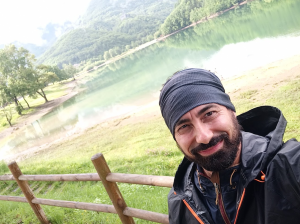
"The real voyage of discovery consists not in seeking new lands, but in having new eyes." (Marcel Proust)
Contact: gianmarco.guidetti@unibas.it
The main expected outcome at the end of the PhD activities is the updated geological mapping in the epicentral area of the 1980 earthquake. The study area is part of the national CARG Project for geological updating at a 1:50,000 scale, overseen by ISPRA, specifically in sheet no. 469 'Muro Lucano.' Another goal of the project is to better characterize the network of exposed faults in the area, which could contribute to a better understanding of the active seismicity and the actual hazard.
How my position is funded
The research project is funded by the Department of Sciences and is part of the national framework of the CARG Project by ISPRA for geological mapping at a 1:50,000 scale of sheet no. 469 'Muro Lucano' (Basilicata).
https://www.isprambiente.gov.it/en/ispra-services/forms-and-services/the-geological-survey-of-italy/geological-and-geothematic-maps/geological-map-at-the-scale-1-to-50000
My motivations
Contributing to the creation of a geological map for the CARG project represents an important educational opportunity. One of the motivations is to acquire new techniques and methodological tools in order to enhance scientific and professional skills, with the hope of remaining in the field of applied research in an integrated and interdisciplinary way, through collaborations with experts from other scientific and disciplinary fields.
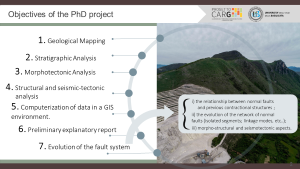
A day in a PhD Student’s life
A typical day for a geologist on a field excursion can vary depending on the mission's objectives, but it generally follows an adventurous and structured routine. Here’s a description of how it might unfold:
1. Early Morning - Preparation
The geologist wakes up early to take advantage of daylight. After a hearty breakfast, they prepare all the necessary equipment: geologist’s hammer, GPS, compass, geological maps, notebook, rock samples. They wear technical clothing and sturdy boots suited for rough terrain.
2. Travel to the Site
Once ready, the geologist heads to the study site. This can mean a long hike in the mountains, across a desert, along the coast, or even to a quarry. The journey to the site is already part of the work, as the geologist carefully observes the characteristics of the terrain, rocks, and formations along the way.
3. On-Site Analysis
At the site, the geologist starts gathering data. This can include:
- Visual Observations: Identifying rock types, stratification, folds or faults, and geomorphological features.
- Geological Surveys: Using a compass and clinometer to measure the dip and strike of rock layers or faults.
- Sample Collection: Gathering rock, mineral, or soil samples for further analysis in the lab.
- Photos and Documentation: Recording every detail in a notebook or through photographs to preserve information for later analysis
During this process, the geologist might interact with other team members, discussing observations or consulting maps to determine the geology of the area.
4. Lunch Break
Around midday, the geologist takes a break to eat, usually in the field. During this time, they might also discuss the work done so far or plan the next steps for the day.
5. Continuing Data Collection
In the afternoon, the geologist continues collecting samples and measurements. Sometimes, this involves moving to different sites or exploring various sections of the same area, comparing geological layers or studying local phenomena like landslides or volcanic activity.
6. Return to Base
In the late afternoon, after completing the fieldwork, the geologist returns to base or camp. Before sunset, they might quickly review the data collected, check the maps, review photographs, and jot down additional observations or reflections.
7. Evening - Organization and Preparation
The day ends with organizing the gathered material: samples are labeled, the notebook is updated with more details, and the geologist plans for the next day’s activities. This may include reviewing the data collected and preparing tools for the following day.
8. Relax and Rest
After a long day, the geologist takes some time to relax, often in an outdoor camp or nearby accommodation. The evening is a time to reflect on discoveries, share opinions with colleagues, and mentally prepare for the work ahead.
Key Aspects:
- Safety Awareness: Throughout the day, safety is a priority, especially when working in remote or rugged environments.
- Adaptability: Weather conditions or terrain may affect the geologist’s work, requiring them to adapt plans accordingly.
In essence, a day in the field for a geologist is a mix of adventure, scientific observation, and precise data collection, all while being immersed in nature and the geological landscape.
My events
Course with certified evaluation – Scuola Estiva di Rilevamento Geologico e cartografia CARG, Alpi Apuane;
Joint Congress SIMP, SGI, SOGEI, AIV - The Geoscience paradigm: Resources, Risks and future perspectives.
https://www.socgeol.it/N5472/congresso-congiunto-simp-sgi-sogei-aiv-the-geoscience-paradigm-resources-risks-and-future-perspectives.html
Seminar 12/01/2023. Geofluidi e terremoti: predire l’imprevedibile;
Seminar 25/01/2023. Bio Trattamenti per la conservazione di manufatti metallici rinvenuti nell’area del Mediterraneo;
Seminar 10/02/2023. Il clima e il riscaldamento globale;
Seminar 08/03/2023. Analisi di strutture fragili e circolazione di fluidi in unità alloctone mesozoiche affioranti in Val d’Agri;
Seminar 13/04/2023. Rilevamento geologico 1:10000 delle aree di Castelgrande e Muro Lucano (Pz): risultati, novità e futuro lavoro;
Seminar 18/05/2023. Reservoir-scale structural architecture of basin-bounding faults in Mesozoic plantform carbonates;
Seminar 06-07/06/2023 e 10-11/06/2023. Il Progetto CARG - Campo estivo CARG Alpi Apuane 2023;
Seminar 07/06/2023. Presentazione del congresso congiunto SIMP-SGI-SoGeI-AIV 2023;
Seminar 20/06/23. Geochimica e mineralogia dei sedimenti lacustri: il caso dell’invaso Pietra del Pertusillo.
Poster - Lucente S., Bentivenga M., Cantarelli V., Giordano A., Prosser G., Rizzo G., Soldo G., Baggi I.G. & Guidetti G. (2023) Disclosure of geological sciences through the geosites: the example of Geoscuola project in Basilicata. Congresso congiunto SIMP, SGI, SOGEI, AIV - The Geoscience paradigm: Resources, Risks and future perspectives. Potenza 19-21 September 2023.
Abstract - Bentivenga M., Nappi A., Guidetti G., Lucente S., Giordano A., Oliveto S., Guerra J. G., Minervino A., Cerone D. & Prosser G. (2023) The itinerary of Muro Lucano, in Basilicata: between geology, archeology and industrial archeology. Congresso congiunto SIMP, SGI, SOGEI, AIV - The Geoscience paradigm: Resources, Risks and future perspectives. Potenza 19-21 September 2023.Abstract – Bellanova J., Calamita G., Guidetti G., Montano P., Perrone A., Piscitelli S. & G. Prosser (2024). Electrical Resistivity tomographies for the structural and seismotectonic setting analysis of the Pantano di San Gregorio Magno (Sa). Workshop On Electromagnetic Studies Of Earthquakes And Volcanoes (EMSEV). Creta 6-9 October 2024
My publications
Pubblicazioni – Guidetti G., Bentivenga M., Cantarelli V., Prosser G., Rizzo G., Soldo G., Baggi I. G. & Lucente S. (2023). Disseminating Geosciences Through Geosites: The Example Of “Geoscuola” Project In Basilicata. RENDICONTI ONLINE DELLA SOCIETÀ GEOLOGICA ITALIANA, 61, 116-123.
Useful links:
https://www.linkedin.com/in/giammarco-guidetti-02a474ab/