

Umberto Calice
A journey of personal and scientific growth.”
Contact: umberto.calice@unibas.it
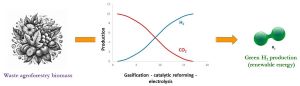
The global energy landscape is undergoing a radical transformation as countries and industries seek sustainable and clean alternatives to traditional methods of energy production, such as the use of fossil fuels. Hydrogen, with its high energy content and potential to produce zero-emission energy, has emerged as a promising candidate to address these challenges. One avenue of hydrogen production that is garnering significant attention is the utilization of biomass from agro-industrial waste, a renewable and abundant resource.
The objectives of this doctoral program involve the development of innovative processes for biomass gasification, catalytic reforming, and electrolysis for hydrogen production from biomass, such as agro-industrial residues. The focus is on optimizing process parameters through experimental investigations. The aim is to enhance the treatment of volatile organic compounds (VOCs) and steam catalytic reforming of TARs by synthesizing and testing new catalysts, thus increasing hydrogen yields for the synthesis of biofuels. The program also seeks to treat and convert wastewater from gasification plants, utilizing advanced analytical techniques and electrochemical processes to produce hydrogen. Valuable bioactive substances will be extracted and characterized from the biomasses used for these purposes. Experiments will be optimized using Design of Experiments software, and the obtained data will aid in improving process design, employing simulation software for material and energy balances. In general, this research is committed to promoting sustainable energy production and obtaining valuable bioactive products from biomass. The main reference methodologies for the implementation of this doctoral project will involve advanced analysis techniques such as HPLC, HPIC, GC-MS, FTIR, and UV, NMR, for the chemical and physical determination of biomass extracts before and after treatments. Techniques for extracting, isolating, and purifying useful bioactive substances from biomasses will be employed, including the use of deep eutectic solvents (DES). To determine the optimal process parameters for hydrogen production from biomass, experiments will be conducted using ENEA equipment and facilities. This approach will lead to the development of innovative processes for gasification, catalytic reforming, and electrolysis, to be used for methanol synthesis and other e-fuels. Experimental tests will be scheduled and optimized using Design of Experiment (DOE) software. The experimental data will serve as the basis for creating process layouts aimed at solving material and energy balances, using specific simulation software. For improving the catalytic steam reforming of TARs (Tars and Heavy Oils) and the upgrading of VOCs, suitable catalysts will be synthesized. This will involve synthesis methods, separation techniques (via chromatographic methods), and compound characterization (using GC-MS, 13C-NMR, 1H-NMR, Computational methods).
How my position is funded
My PhD position is funded by ENEA under the MiTE-ENEA Program Agreement for conducting research activities within the National Recovery and Resilience Plan (PNRR) – Mission 2 – Component 2 – Investment 3.5, financed by the European Union's Next Generation EU, Operational Research Plan 'Research and development of technologies for the hydrogen supply chain', specifically focusing on 'Hydrogen production from biomass through processes of gasification, catalytic reforming, and electrolysis'. For more information, please refer to the project details: https://www.mase.gov.it/comunicati/pnrr-firmato-accordo-di-programma-mite-enea-ricerca-sull-idrogeno
My motivations
I chose to pursue further studies and obtain a PhD because, during my Bachelor's and Master's thesis, I realized that I truly enjoy the world of chemical research. This realization motivated me to continue down this path. Upon obtaining my PhD, I aspire to keep engaging in research, contributing to the advancement of chemistry, and expanding our understanding of molecular science. My passion for discovery and innovation drives me to seek a future where I can make significant contributions to the field.
A day in a PhD student’s life
My typical day as a PhD student begins with an update on the state of the art in my research field. It continues with a review of the activity report written the previous day. At this point, I engage in laboratory activities in collaboration with my colleagues, collecting experimental results and performing data analysis. At the end of the day, I update the activity diary with a new report and discuss the obtained results with my supervisors. This daily routine allows me to maintain a clear and updated view of my research project, ensuring that each step is carefully documented and evaluated.
My events
SCI 2024 - XXVIII National Congress of Società Chimica Italiana MILANO, 26th - 30th of August 2024 – Poster communication: “Prismarene macrocycles as chirality sensors” Calice, Umberto; Della Sala, Paolo; Gaeta, Carmine; Superchi, Stefano
My publications
P. Della Sala, U. Calice, V. Iuliano, S. Geremia, N. Hickey, S. Belviso, F. F. Summa, G. Monaco, C. Gaeta, S. Superchi, Chem. Eur. J. 2024, e202401625. https://doi.org/10.1002/chem.202401625
Optical chirality sensing has gained significant attention recently, with stereodynamic chiroptical probes for detecting cryptochiral guests being a formidable challenge. Macrocycles with planar chirality, like prismarenes, show promise in amplifying the chirality of these guests. This study demonstrates that host-guest complexes between cryptochiral molecules and planar chiral prismarenes trigger ECD signals through chirality amplification. The most stable chiral macrocyclic host-guest complex's absolute configuration was established using exciton model and DFT computations. Additionally, this supramolecular chirality sensing system can determine the enantiomeric composition of scalemic mixtures by measuring ECD band intensity, paving the way for prismarenes as stereodynamic probes for cryptochiral guests.